Microsoft Build 2026: Seven new MAI models and why Frontier Tuning changes the enterprise AI equation
Microsoft launched 7 new MAI models at Build 2026. Here's what they are, and why Frontier Tuning, their new RL-based enterprise approach, matters.
DS
Data Science Dojo Staff · 8 min read
Key Takeaways
At Microsoft Build 2026, Microsoft launched seven new in-house MAI models spanning reasoning, coding, image, voice, and transcription.
Microsoft Frontier Tuning applies reinforcement learning inside your organization’s compliance boundary — teaching MAI models to work the way your business actually works.
Early results are stark: one internal Microsoft deployment saw task completion jump from 13% to 87% after Frontier Tuning.
At Microsoft Build 2026, Microsoft didn’t just ship models. Mustafa Suleyman described the project as building a “hill-climbing machine” — an organization designed to improve cycle after cycle as compute scales. The seven new MAI models are the first output of that machine. But the more consequential announcement from Microsoft Build is what you can now do with those models once you have them: Frontier Tuning.
The Microsoft MAI Model Family, Broken Down
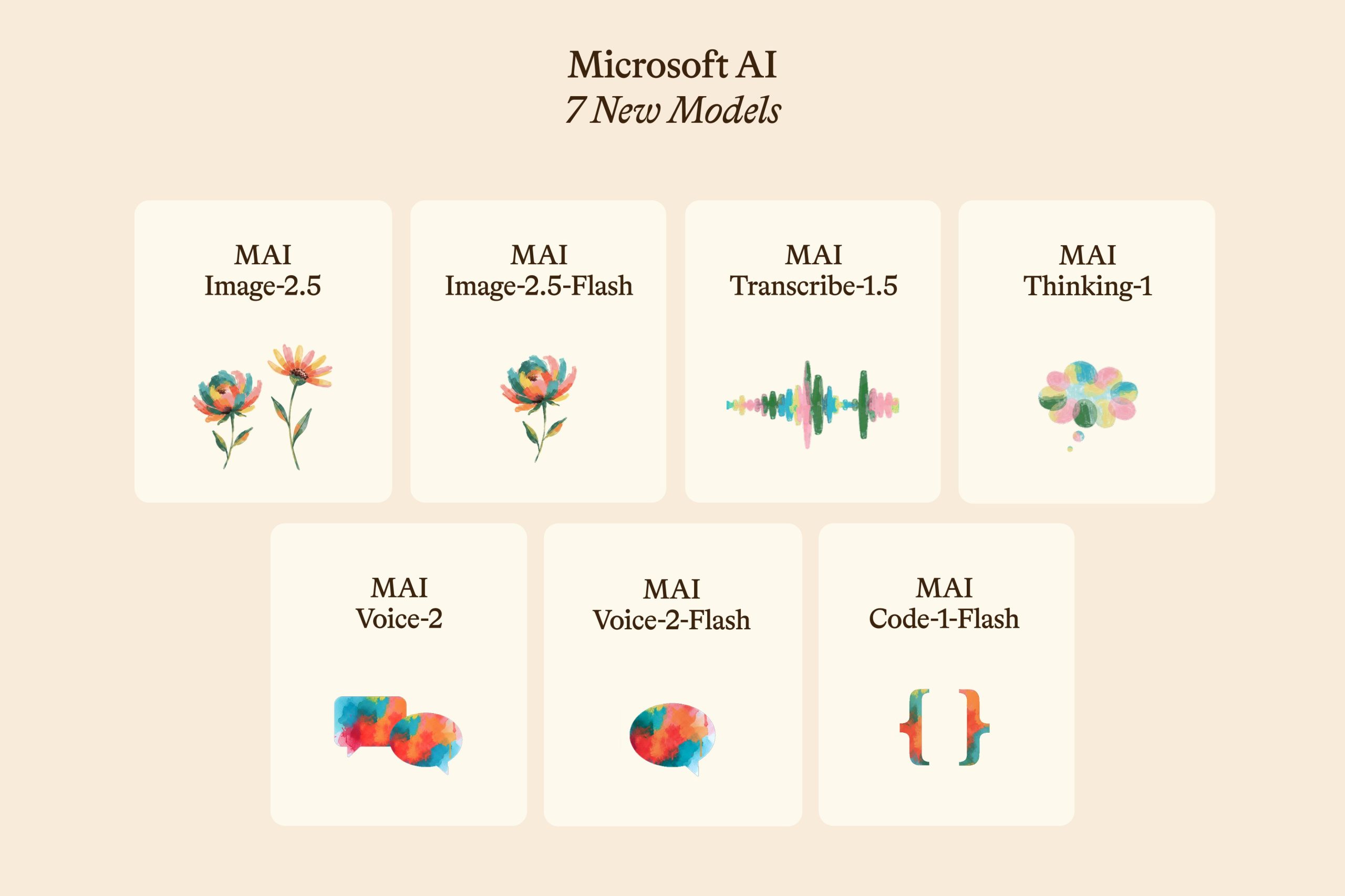
Microsoft’s new MAI lineup covers five modalities and is designed to work as an integrated ecosystem rather than a collection of standalone offerings.
All seven Microsoft MAI models were trained from scratch on clean, human-sourced, appropriately licensed data — deliberately avoiding distillation from third-party models or AI-generated content to prevent model collapse, where models trained on synthetic data progressively degrade in quality over generations.
MAI-Thinking-1: Microsoft MAI’s flagship reasoning model. Mid-weight, trained to match leading models on software engineering benchmarks, and reaches human preference parity with Claude Sonnet 4.6 in blind evaluations. Built for the complex multi-step problems that matter most.
MAI-Code-1-Flash: An inference-efficient agentic coding model with 5 billion parameters. Deeply integrated into GitHub Copilot and VS Code, and priced comparably to Claude Haiku.
MAI-Image-2.5: Supports both text-to-image generation and image editing. Launched at No. 2 on the Arena ELO leaderboard for image editing, with a Flash variant for lower-cost use cases.
MAI-Transcribe-1.5: Claims state-of-the-art transcription accuracy across 43 languages, with domain-specific terminology support and five times the inference speed of competing models.
MAI-Voice-2: Natural speech synthesis across 15 languages, with voice adaptation from short audio samples.
source: Microsoft AI
What ties these MAI models together is a shared foundation: the same data discipline, the same infrastructure, and the same evaluation framework. They are also co-designed with Microsoft’s own Maia 200 silicon, which is already showing a 1.4x efficiency advantage over third-party hardware at scale.
Why Microsoft Frontier Tuning Is the More Important Story From Microsoft Build
The MAI model releases are notable, but they follow a pattern the industry recognizes. The genuinely new piece at Microsoft Build 2026 is Frontier Tuning and it represents a different bet on where enterprise AI value actually comes from.
The premise is straightforward: generic frontier models, no matter how capable, don’t know how your organization works. They don’t know your terminology, your approval chains, your document conventions, or the sequence of steps your analysts actually follow to complete a task.
Frontier Tuning is Microsoft’s attempt to close that gap using reinforcement learning, not just fine-tuning on static datasets.
This is worth understanding precisely. Traditional fine-tuning updates a model’s weights on labeled examples of what good output looks like. Reinforcement learning goes further — the model learns from the trace of actual work being done: the sequence of tool calls, the decisions made, the corrections applied, the outcomes achieved. Microsoft Frontier Tuning learns from process, not just examples.
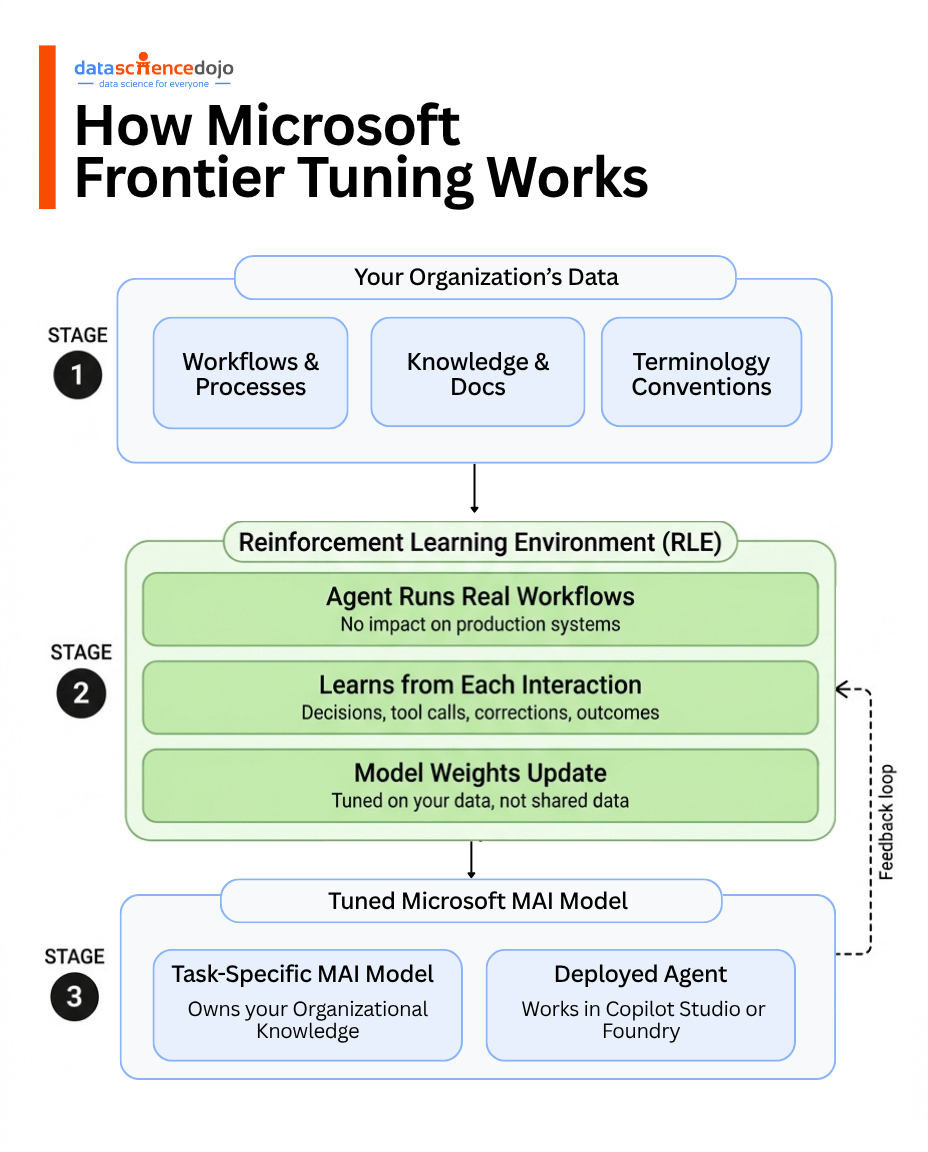
Frontier Tuning has three components that operate as a continuous loop:
A Reinforcement Learning Environment (RLE): A managed training and inference environment where the system learns from real workflows without touching production systems. During inference, the RLE explores multiple frontier and fine-tuned MAI model paths before returning a response, improving with each interaction.
Your organization’s data and workflows: Content, processes, conventions, terminology, and knowledge bases that define how your business operates. Brought into the RLE through a guided interface that doesn’t require a data science team to set up.
Tuned outputs that stay within your compliance boundary: Frontier Tuning produces tuned models, skills, orchestration logic, and a runtime harness. Access controls are inherited from the underlying data, meaning only people who could already see that data can access models built from it.
The architecture matters for a specific reason: your institutional knowledge stays yours. You’re not contributing data to a shared model or improving a vendor’s general-purpose offering. The Frontier Tuning output runs in your environment, under your controls, and model weights can now be taken by developers and used directly.
[IMAGE: Diagram showing the Microsoft Frontier Tuning loop — organization data flows into the RLE, the RLE produces tuned MAI models and skills, agents improve through interaction]
The Numbers From Microsoft Frontier Tuning’s Early Deployments
source: Microsoft AI
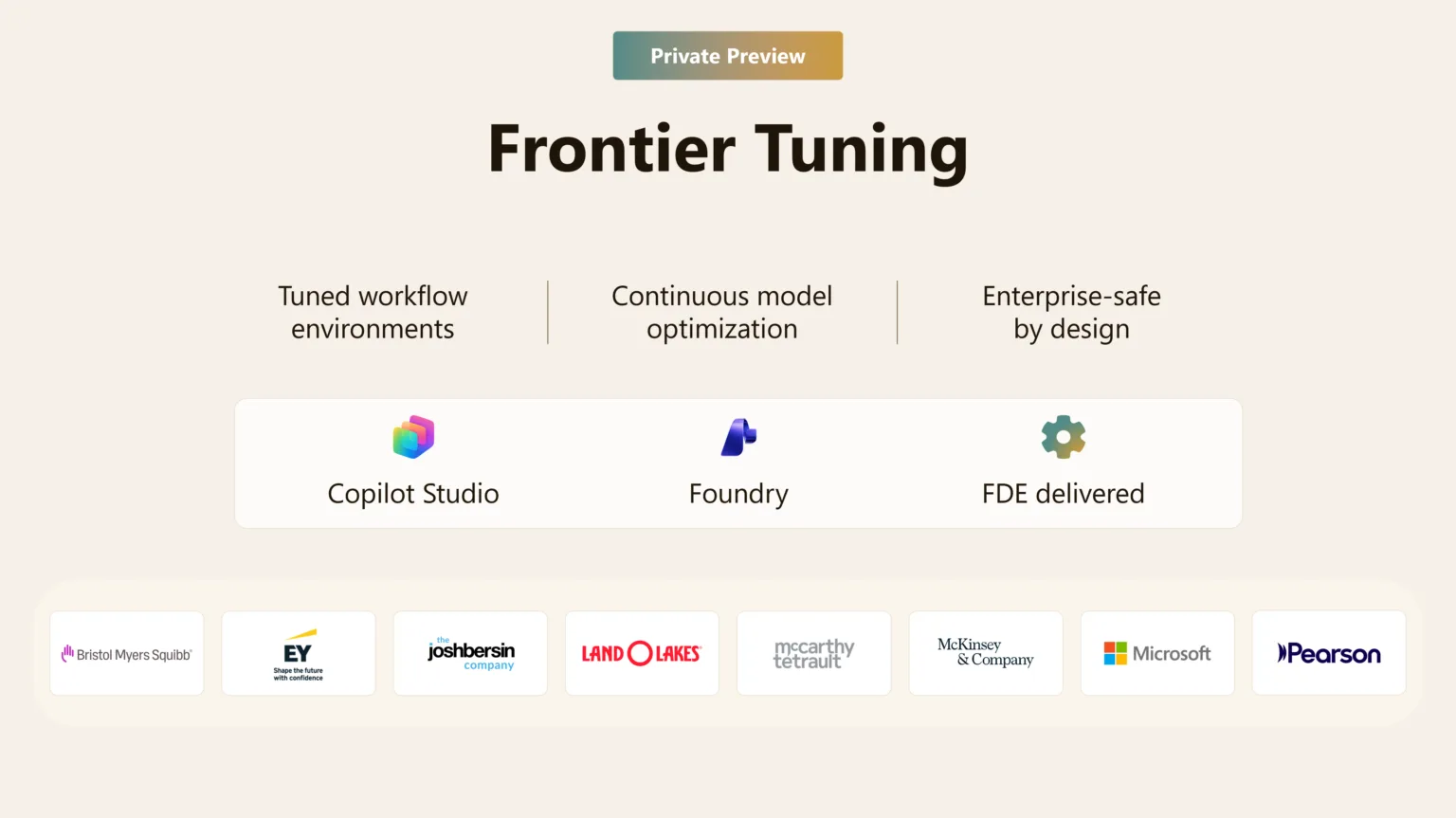
Microsoft is already running Frontier Tuning with a focused set of enterprise partners, and the results follow a consistent pattern.
Microsoft HR workflows: Task completion increased from 13% to 87% after Frontier Tuning on internal HR processes.
McKinsey: An MAI model tuned to McKinsey’s standards achieved the highest win rate of any model tested at approximately 10x lower cost than general-purpose alternatives.
Excel: A Microsoft MAI model tuned for Excel tasks matches GPT-5.4 performance while being up to 10x more efficient.
EY: Deploying a tax-domain tuned reasoning LLM to 75,000 tax professionals globally, built inside the Frontier Tuning RLE using EY’s own knowledge and client context.
Pearson: Reported significantly better Copilot outputs for their Communication Coach product, with outputs more closely aligned to Pearson’s learning science.
The efficiency gains are worth dwelling on. A Microsoft MAI model that is both better at a specific task and cheaper to run isn’t a minor upgrade — it changes the economics of deploying AI at enterprise scale. The 13% to 87% task completion figure from Microsoft Frontier Tuning’s HR deployment is the kind of outcome that makes a business case write itself.
Where Microsoft Frontier Tuning Fits in the Enterprise Stack
Frontier Tuning is entering private preview through three routes:
Microsoft Copilot Studio — Makers can access the RLE and use transcripts, knowledge bases, and Microsoft 365 artifacts to improve existing agents with Frontier Tuning.
Microsoft Foundry — Developers can set up an RLE, bring in data, and tune Microsoft MAI models and runtime behavior alongside existing tooling. Details on Foundry support are expected in coming months.
Forward Deployed Engineers (FDE) — Microsoft’s FDE team partners with organizations end-to-end: defining the scenario, setting evaluation criteria, running the Frontier Tuning process, and delivering the agent — all within the customer’s environment.
For teams already building on Copilot Studio or Foundry, Frontier Tuning is an extension of existing workflows rather than a separate platform. The harder question for most organizations is not whether to adopt it, but how to identify which workflows have enough structure and historical data to make tuning worthwhile.
For a deeper understanding of how LLM fine-tuning works and when to apply it, the mechanics of Frontier Tuning sit closer to reinforcement fine-tuning than supervised fine-tuning — the distinction becomes relevant when deciding what data you need and how to evaluate whether the tuned Microsoft MAI model is actually better.
The Mayo Clinic Partnership and Domain-Specific AI at Microsoft Build 2026
Alongside the Microsoft MAI and Frontier Tuning announcements, Microsoft Build 2026 also revealed a collaboration with Mayo Clinic to co-create a frontier AI model specifically for healthcare. The model will draw on Mayo’s de-identified clinical data and longitudinal insights combined with Microsoft’s foundational AI capabilities.
The model deploys first within Mayo Clinic’s own environment, then becomes available to other organizations through Azure Foundry once validated. It will be owned by Mayo Clinic — a structural choice that reflects the same data sovereignty logic as Microsoft Frontier Tuning. When clinical data and institutional trust are involved, ownership isn’t just a compliance requirement; it’s a prerequisite for clinical adoption.
What Microsoft Build 2026 Means for Builders
The Microsoft MAI model family gives developers access to competitive models across more modalities — particularly for transcription and image tasks where MAI-Transcribe-1.5 and MAI-Image-2.5 are making specific benchmark claims worth testing against your actual use cases.
Microsoft Frontier Tuning is a longer-term consideration. The private preview path means most teams won’t have direct access immediately, but the architecture is worth understanding now:
Data readiness matters more than model choice — The ceiling of what Frontier Tuning can achieve is set by the quality, structure, and coverage of your workflow data.
Evaluation criteria need to be defined before tuning starts — The RLE learns from feedback signals. Organizations that have invested in agentic AI evaluation and governance frameworks will be better positioned to run a meaningful Frontier Tuning process.
The efficiency argument is real — A 10x cost reduction on a task-specific Microsoft MAI model compared to a general frontier alternative is a meaningful number for any production deployment at scale.
Microsoft’s bet, made explicit at Microsoft Build 2026, is that the most valuable AI in an organization won’t be the most capable general model — it will be the Microsoft MAI model that knows exactly how that organization works. Frontier Tuning is the infrastructure for that bet. The Microsoft Build 2026 announcements are the starting line, not the finish.
Want to build AI agents that can reason, plan, and execute autonomously?