We are moving beyond single-model interactions and prompt-based workflows toward agentic AI systems—AI agents that can reason, plan, take action, and collaborate across tools, data sources, and environments. This shift has profound implications for how software is built, deployed, and governed.
To support this transition responsibly and at scale, the Linux Foundation has announced the formation of the Agentic AI Foundation (AAIF) a new, neutral home for open collaboration on agentic AI technologies.
We are excited to share that Data Science Dojo has joined the Agentic AI Foundation as a Silver Member, alongside a growing ecosystem of organizations working together to define open standards, protocols, and best practices for agentic AI.
What Is the Agentic AI Foundation (AAIF)?
The Agentic AI Foundation (AAIF) is a newly launched initiative under the Linux Foundation, designed to provide neutral governance and open collaboration for the rapidly evolving field of agentic AI.
The Linux Foundation has a long history of stewarding foundational technologies that power modern computing—from Linux itself to Kubernetes and beyond. With AAIF, the Foundation is applying that same open, community-driven model to agentic AI.
At its core, Agentic AI Foundation exists to:
Foster open standards for AI agents
Enable interoperability across tools, models, and platforms
Encourage responsible, transparent development of agentic systems
Reduce fragmentation as the ecosystem grows
Rather than being controlled by any single vendor or platform, AAIF provides a shared space where industry leaders, startups, researchers, and practitioners can collaborate on the building blocks of agentic AI.
Foundational Projects Under AAIF
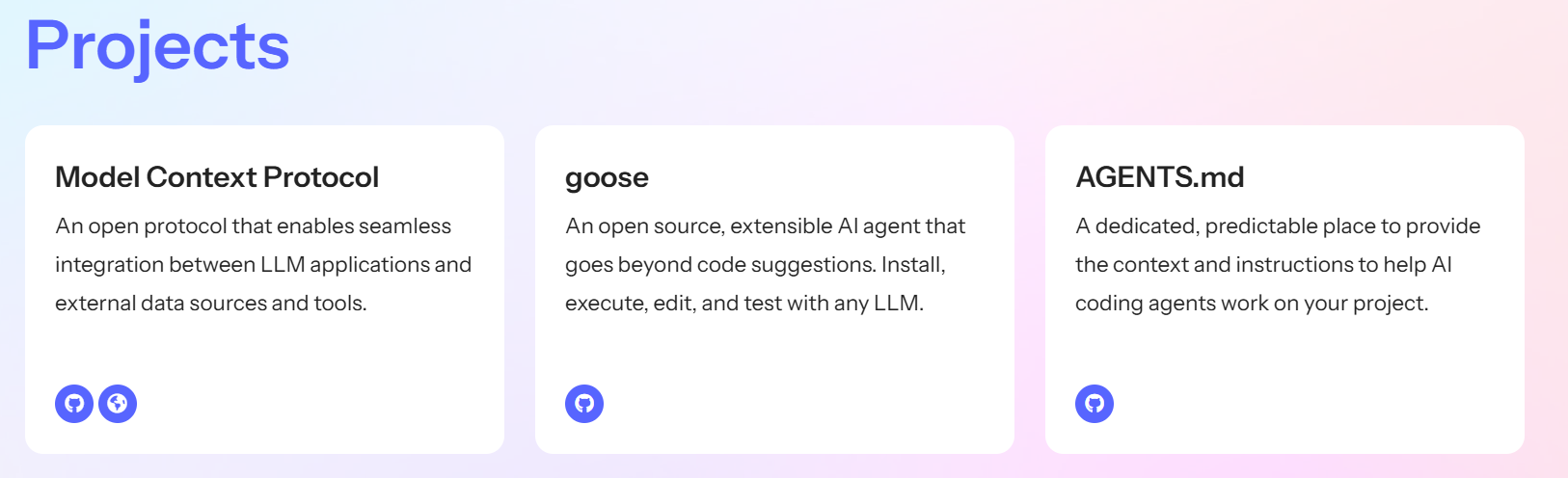
Agentic AI Foundation launches with several important open-source projects from OpenAi, Anthropic that reflect the practical needs of agentic systems:
Model Context Protocol (MCP)
A protocol designed to standardize how AI models interact with external tools, data sources, and applications, enabling agents to operate across environments in a consistent way
An extensible framework for building and running AI agents, designed to support experimentation and production use cases alike.
AGENTS.md
A proposed standard that defines how AI coding agents should behave across repositories and projects, bringing clarity and consistency to human–agent collaboration.
Together, these projects aim to solve a growing problem in the AI ecosystem: powerful agents without shared conventions are difficult to integrate, govern, and scale.
source: Agentic AI Foundation
Why Agentic AI Needs Open Standards
Agentic AI represents a step change in capability. These systems don’t just generate text or predictions—they take actions, coordinate workflows, and make decisions across systems.
Without shared standards, this evolution introduces real risks:
Fragmented agent frameworks that cannot interoperate
Tight coupling between agents and proprietary platforms
Inconsistent behavior across environments
Difficulty auditing or governing agent actions
Open standards help address these challenges.
By defining common protocols and interfaces, initiatives like AAIF make it possible for:
Developers to build agents that work across tools and ecosystems
Organizations to adopt agentic AI without vendor lock-in
Enterprises to apply governance, security, and compliance controls consistently
Innovation to happen faster through shared foundations
This mirrors what we’ve seen repeatedly in the history of computing: open systems scale, while closed silos struggle to keep up with ecosystem-wide innovation.
Agentic AI is no different.
Data Science Dojo & the Agentic AI Foundation
At Data Science Dojo, our mission has always been rooted in practical, responsible AI adoption, helping organizations understand not just what is possible, but how to build systems that work in the real world.
Joining the Agentic AI Foundation as a Silver Member aligns naturally with that mission.
Alignment with Our Values
AAIF’s emphasis on openness, collaboration, and neutral governance reflects the principles we believe are essential for the next generation of AI systems.
Agentic AI will increasingly operate in production environments, touching critical workflows, data pipelines, and decision-making processes. Open standards are not optional, they are foundational.
Membership in AAIF allows us to actively participate in:
Discussions around emerging agentic AI standards
The evolution of protocols like MCP
Best practices for designing and deploying AI agents responsibly
This ensures that the perspectives of practitioners, educators, and enterprise adopters are represented alongside platform providers and infrastructure vendors.
Supporting the Broader Ecosystem
As educators, consultants, and practitioners, we see firsthand how quickly new AI capabilities are adopted—often before standards catch up. By contributing to AAIF, we can help bridge that gap, supporting an ecosystem where innovation and responsibility evolve together.
What This Means for Our Clients and Community
Our participation in the Agentic AI Foundation isn’t just symbolic—it has practical implications for the people and organizations we work with every day.
Better Guidance on Agentic AI Adoption
As agentic AI moves from experimentation to production, organizations will need clarity around:
Architecture patterns
Tool interoperability
Governance and oversight
Long-term maintainability
Being part of AAIF allows us to stay closely aligned with emerging standards and industry consensus, so we can provide more informed guidance.
Reduced Risk and Greater Trust
Open standards reduce uncertainty. They make it easier to evaluate technologies, avoid lock-in, and design systems that can evolve over time. For organizations investing in agentic AI, this translates directly into lower risk and higher confidence.
Community-Driven Innovation
AAIF is not just about specifications, it’s about community. By participating in open projects, discussions, and events, we can help ensure that agentic AI evolves in ways that benefit a broad range of users, not just a narrow set of platforms.
The formation of the Agentic AI Foundation signals something important: agentic AI is no longer a niche concept. It is becoming core infrastructure.
When the Linux Foundation steps in to provide governance and stewardship, it’s a strong indicator that the technology has reached a level of maturity, and importance, where collaboration matters more than competition alone. The presence of organizations across cloud providers, AI platforms, tooling companies, and services firms underscores the shared recognition that no single entity should define how agentic AI works.
Looking Ahead
Agentic AI has the potential to redefine how software systems operate, moving from passive tools to active collaborators. But realizing that potential requires shared foundations. We’re proud to join the Agentic AI Foundation as a Silver Member, and we look forward to contributing to an open, interoperable, and responsible agentic AI ecosystem.
We’ll be sharing more insights as this space evolves, covering standards, real-world use cases, and what agentic AI means for organizations navigating this next chapter of AI adoption. If you’re exploring agentic AI or want to understand how open standards can support your initiatives, we’d love to continue the conversation.
Ready to build robust and scalable LLM Applications? Explore Data Science Dojo’s LLM Bootcamp and Agentic AI Bootcamp for hands-on training in building production-grade retrieval-augmented and agentic AI systems.
Subscribe to our newsletter
Monthly curated AI content, Data Science Dojo updates, and more.