
Key Takeaways
- Microsoft CEO Satya Nadella warns that if a handful of AI models capture most of the economic value, it will repeat the damage caused by outsourcing during early globalization, just applied to knowledge work instead of manufacturing.
- His proposed fix is for every company to build its own “token capital”: AI systems trained on internal workflows, data, and judgment, not just rented access to a general-purpose model.
- In practice, this means documenting workflows, building an internal knowledge base, running private evaluations tied to business outcomes, and feeding real usage data back into the system over time.
What Satya Nadella Actually Said
Satya Nadella recently published an essay warning about where AI could be headed for businesses.
His core claim: if only a few AI models end up capturing most of the value created by AI, the broader economy will not accept it.
He draws a direct comparison to early globalization:
- Entire industries were hollowed out by outsourcing
- GDP numbers looked fine on paper
- The impact on workers and local economies lasted for decades
Satya Nadella’s concern is that AI could repeat this pattern with knowledge work. If every company plugs into the same general-purpose models without building anything of their own, those models slowly absorb each company’s expertise and turn it into something replaceable.
The companies that recognize this early, and start building their own AI capability on top of their own data, will be the ones with a real advantage.
Human Capital and Token Capital
Satya Nadella splits company value into two parts:
- Human capital: the knowledge, judgment, relationships, and pattern recognition your team has built up over years
- Token capital: the AI systems your company owns and trains, built on your own workflows and data
The important point is that these two reinforce each other instead of competing.
As token capital grows, human capital becomes more valuable, not less. People are still the ones deciding what problems matter, setting direction, and judging whether the AI’s output is actually good. Without that human input, you just have a model running in circles with nothing useful to learn from.
What Building “Token Capital” Actually Looks Like
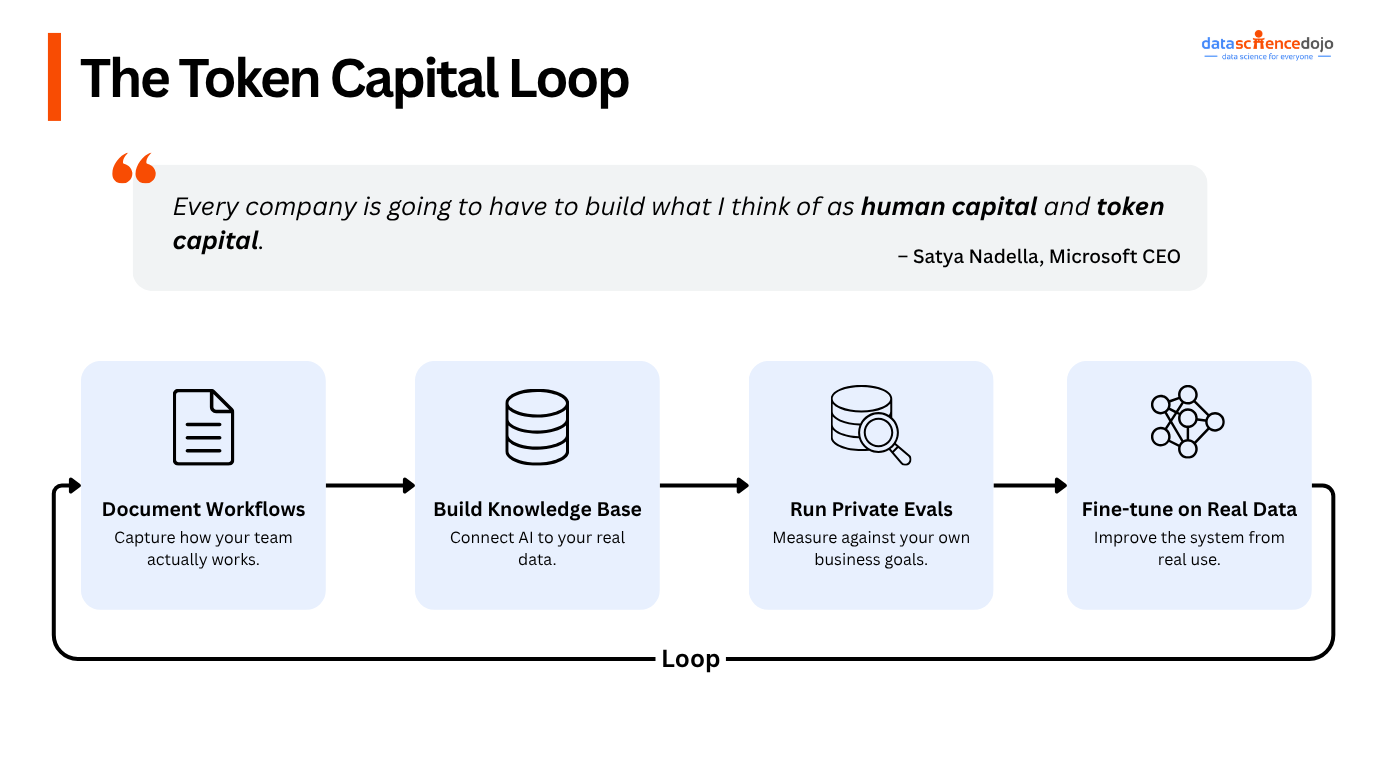
This is the part that matters most for teams working in data and AI right now. None of this is abstract. It comes down to a few concrete steps:
- Document your workflows. If a process only exists in someone’s head, an AI system has nothing to learn from. Writing down how your team actually gets things done is the starting point.
- Build a knowledge base your AI can use. This usually means setting up a retrieval system so your AI tools can pull from your company’s real documents, past projects, and internal expertise, not just generic web data.
- Run evaluations based on your own goals. Public benchmarks measure how a model performs on test questions. They don’t tell you whether it’s helping your team close deals faster, write better reports, or catch errors earlier. Private evals, built around outcomes that matter to your business, are what actually tell you if the system is improving.
- Feed real usage data back into the system. As your team uses these tools, you generate examples of what good output looks like for your specific work. Using that data for fine-tuning or reinforcement learning is how the system gets better at your work, not just work in general.
Together, these steps create what Satya Nadella calls a “learning loop.” Every time someone on the team uses the system and it improves a little as a result, that improvement compounds over time.
If you want a closer look at how these loops actually run in practice, our breakdown of agentic loops and loop engineering walks through how agents plan, evaluate, and adjust step by step.
For the knowledge base piece specifically, a good starting point is understanding agentic RAG, which combines retrieval with the planning and decision-making that makes these systems useful day to day.
📖 Related: Graph RAG vs RAG: Which One Is Truly Smarter for AI Retrieval?
Why This Is Hard to Copy
The practical upside of building this loop: it’s difficult for a competitor to replicate.
- A competitor can use the same base model you do
- What they can’t easily get is the years of refined workflows, internal data, and tuned evaluations sitting inside your systems
This is also why switching the underlying model shouldn’t break everything.
If your token capital is built correctly, swapping out the model becomes a simple upgrade. Your knowledge base, your evals, and your fine-tuned behavior stay intact because they belong to you, not the model provider.
If switching models means starting from zero, that’s a sign your AI capability is sitting with the vendor instead of your company.
📖 Related: Master Fine-Tuning LLMs: Expert Techniques & Best Practices
The Bigger Picture: Building an Ecosystem, Not Just a Model
Satya Nadella frames this as a bigger issue than any single company’s AI strategy.
If value only flows to a small number of AI providers while every other industry gets commoditized, that is not a stable setup for the broader economy. His call is for a “frontier ecosystem” rather than just a “frontier model”: many companies, across many industries, each building and owning their own learning loop.
For teams working hands-on with AI and data, the takeaway is straightforward. The specific model you use matters less than what you build around it. A few things make the biggest difference:
- Documenting workflows
- Building real internal knowledge bases
- Setting up evaluations tied to your own goals
- Feeding your own data back into the system
These are the skills that turn AI from something you rent into capability your company actually owns. If you want a structured way to build out evaluations specifically, our guide to LLM evaluation covers the core methods and metrics teams use to measure whether a model is actually improving.
If this is the direction your team is heading, our Agentic AI and LLM training programs cover these exact building blocks: RAG systems, private evaluations, and fine-tuning on real internal data.
FAQ
What did Satya Nadella mean by an “AI monopoly”? Satya Nadella warned that if a small number of AI models end up capturing most of the economic value generated by AI, the broader economy and political system will not tolerate it, similar to how outsourcing hollowed out entire industries during early globalization.
What is “token capital”? Token capital refers to the AI systems and capabilities a company builds and owns itself, trained on its own workflows, data, and judgment, as opposed to relying entirely on a general-purpose model from an outside provider.
Does building token capital replace human expertise? No. Satya Nadella argues the opposite: human capital, meaning the knowledge, judgment, and relationships of a company’s people, becomes more valuable as token capital grows, because people are the ones directing what the AI should learn and judging whether its output is useful.
What’s a practical first step for a company that wants to build this? Start by documenting a real workflow that your team repeats often, then build a small internal knowledge base around it using retrieval-augmented generation, so an AI tool can reference your actual processes and past work.
Why does switching AI models matter in this context? If a company’s AI capability is built correctly, with its own knowledge base, evaluations, and fine-tuned behavior, switching to a newer model should be a simple upgrade. If switching models means losing everything and starting over, it’s a sign the real capability lives with the vendor, not the company.
Want to build AI agents that can reason, plan, and execute autonomously?
Learn more