As we stand on the brink of the next wave of AI evolution, large action models (LAMs) are emerging as a foundational paradigm to move beyond mere text generation and toward intelligent agents that can act, not just speak. In this post, we’ll explain why LLMs often aren’t enough for truly agentic workflows, how Large Action Models offer a compelling next step, what their core characteristics are, how they’re trained and integrated, and what real-world uses might look like.
Why LLMs aren’t enough for agentic workflows (the need for LAM)
Over the past few years, large language models (LLMs) — models trained to understand and generate human-like text — have made remarkable progress. They can draft emails, write code, summarize documents, answer questions, and even hold conversations. Their strengths lie in language understanding and generation, multimodal inputs, and zero- or few-shot generalization across tasks.
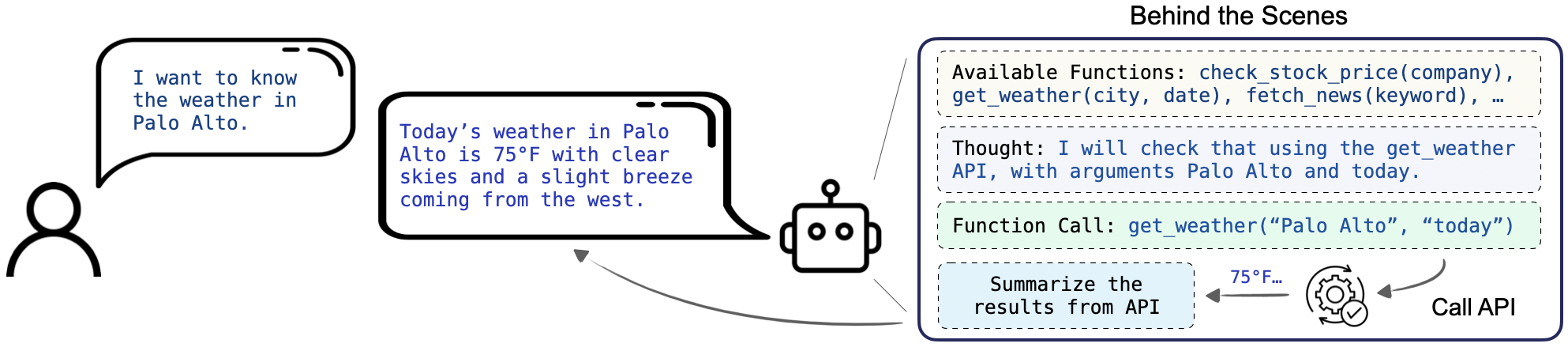
Yet, while LLMs shine in producing coherent and contextually relevant text, they hit a fundamental limitation: they are passive. They output text; they don’t execute actions in the world. That means when a user asks “book me a flight,” or “update my CRM and send follow-up email,” an LLM can produce a plan or instructions but cannot interact with the airline’s booking system, a CRM database, or an email client.
In short: LLMs lack agency. They cannot directly manipulate environments (digital or physical), cannot execute multi-step sequences on behalf of users, and cannot interact with external tools or systems in an autonomous, reliable way.
But many real-world applications demand action, not just advice. Users expect AI agents that can carry out tasks end-to-end: take intent, plan steps, and execute them in real environments. This gap between what LLMs can do and what real-world workflows require is precisely why we need Large Action Models.
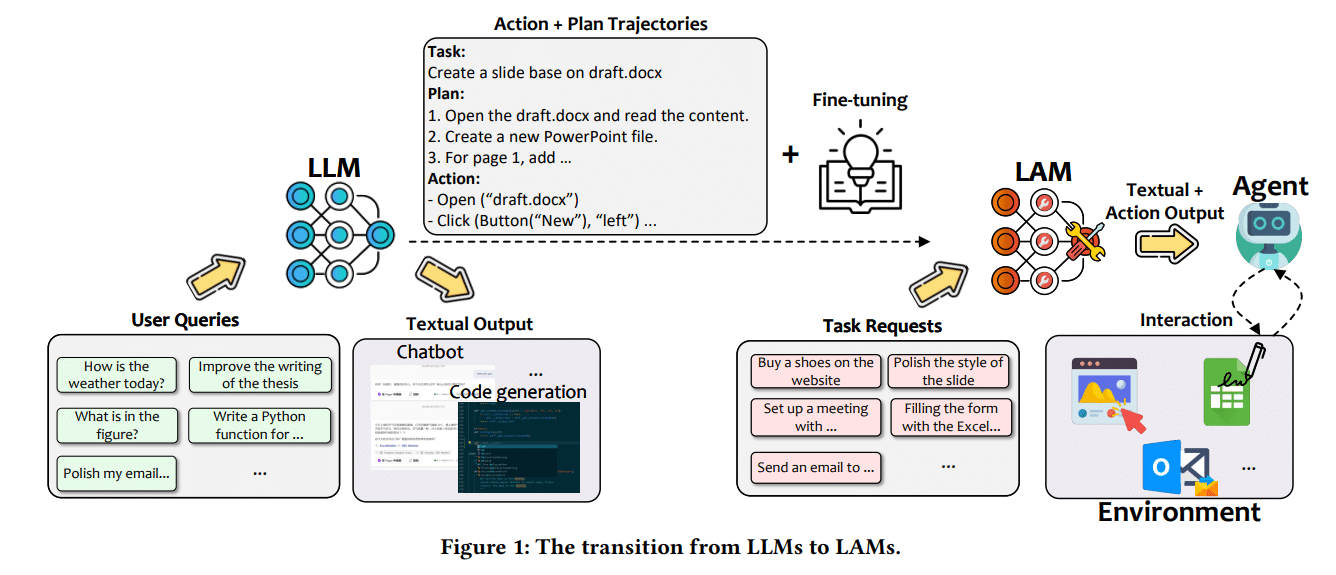
The shift from LLMs to LAMs is more than a simple rebranding — it’s a conceptual transition in how we think about AI’s role. While an LLM remains a “language generator,” a Large Action Model becomes a “doer”.
In the seminal paper Large Action Models: From Inception to Implementation, the authors argue that to build truly autonomous, interactive agents, we need models that go beyond text: models that can interpret commands, plan action sequences, and execute them in a dynamic environment.
One helpful way to visualize the difference: an LLM might respond to “Create a slide deck from draft.docx” by outputting a plan (e.g., “open the draft, create slides, copy content, format, save”), but stops there. A Large Action Model would go further — generating a sequence of actionable commands (e.g., open file, click “New Slide,” copy content, format, save), which an agent can execute in a real GUI environment.
Thus, the transition from LLM to LAM involves not only a shift in output type (text → action) but in role: from assistant or advisor to operative agent.
source: https://arxiv.org/pdf/2412.10047
Characteristics of Large Action Model
What distinguishes LAMs from LLMs? What features enable them to act rather than just talk? Based on the foundational paper and complementary sources, we can identify several defining characteristics:
Interpretation of user intent
Large Action Models must begin by understanding what a user wants, not just as a text prompt, but as a goal or intention to be realized. This involves parsing natural language (or other input modalities), inferring the user’s objectives, constraints, and context.
Once the intent is clear, LAMs don’t output more language — they output actions (or sequences of actions). These actions might correspond to clicking UI elements, typing into forms, executing commands, using APIs, or other interactions with software or systems.
Dynamic planning and adaptation
Real-world tasks often require multi-step workflows, branching logic, error handling, and adaptation to changing environments. Large Action Models must therefore plan sequences of subtasks, decompose high-level goals into actionable steps, and react dynamically if something changes mid-process.
Specialization and efficiency
Because Large Action Models are optimized for action, often in specific environments, they can afford to be more specialized (focused on particular domains, such as desktop GUI automation, web UI interaction, SaaS workflows, etc.) rather than the general-purpose scope of LLMs. This specialization can make them more efficient, both computationally and in terms of reliability, for their target tasks.
Additionally, an important technical dimension: many Large Action Models rely on neuro-symbolic AI — combining the pattern recognition power of neural networks with symbolic reasoning and planning. This hybrid enables them to reason about abstract goals, plan logically structured action sequences, and handle decision-making in a way that pure language models (or pure symbolic systems) struggle with.
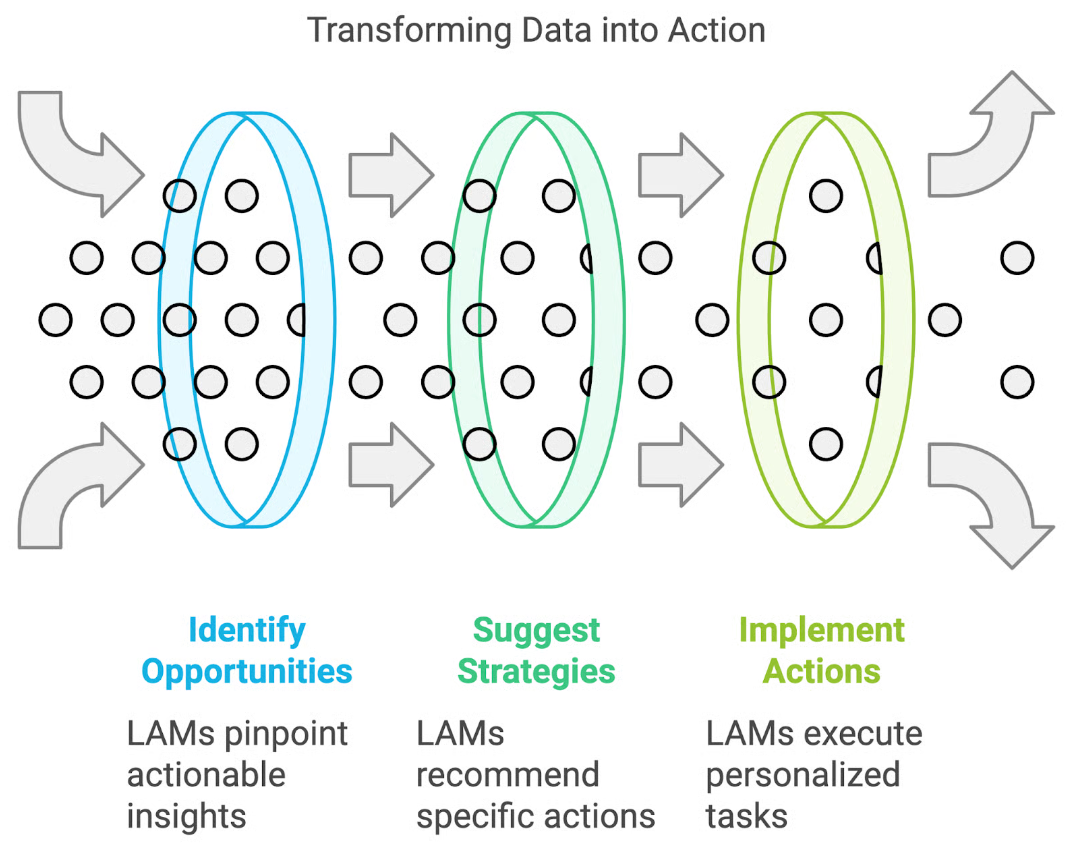
source: Salesforce
How Large Action Models are trained
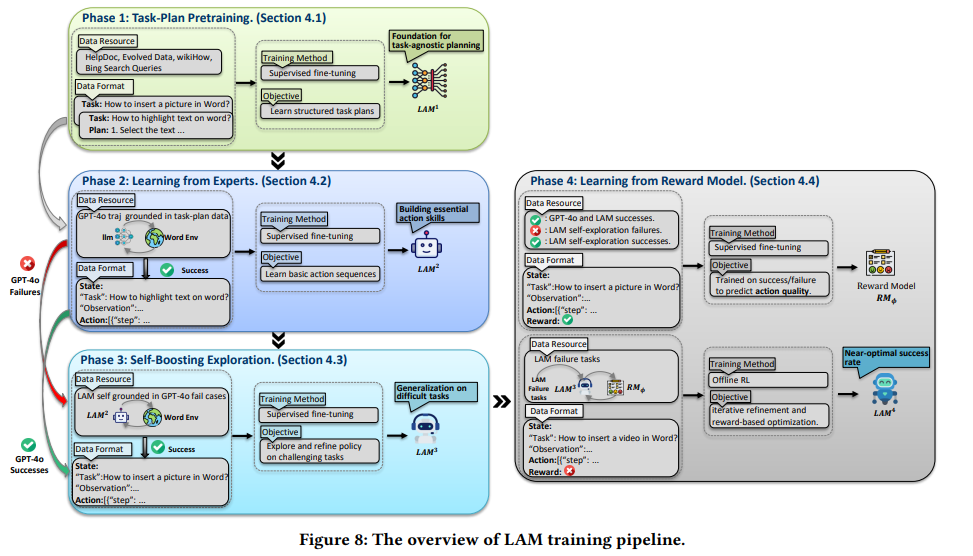
Building a functional LAM is more involved than training a vanilla LLM. The pipeline proposed in the Large Action Models paper outlines a multi-phase workflow.
What kind of data is needed
To train Large Action Models, you need action data, not just text, but records of actual interactions: sequences of actions, environment states before and after each action, and the goal or intent that motivated them. This dataset should reflect realistic workflows: with all their branching logic, mistakes, corrections, variations, and context shifts.
This kind of data can come from “path data”, logs of human users performing tasks, including every click, keystroke, UI state change, timing, and context.
Because such data is more scarce and expensive than plain text corpora (used for LLMs), collecting and curating it properly is more challenging.
source: Datacamp
Why evaluation is so important while training LAMs
Because Large Action Models don’t just generate text — they execute actions — the cost of error is higher. A misgenerated sentence is inconvenient; a mis-generated action could wreak havoc: submit wrong form, delete data, trigger unintended side effects, or even cause security issues.
Therefore rigorous evaluation (both offline and in real- or simulated environments) is critical before deployment. The original paper uses a workflow starting with offline evaluation (on pre-collected data), followed by integration into an agent system, environment grounding, and live testing in a Windows-OS GUI environment.
Evaluation must assess task success rate, robustness to environment changes, error-handling, fallback mechanisms, safety, and generalization beyond the training data.
Integration into agentic frameworks: memory, tools, environment, feedback
Once trained, a Large Action Model must be embedded into a broader agent system. This includes:
Tool integration: the ability to invoke APIs, UI automation frameworks, command-line tools, or other interfaces.
Memory/state tracking: agents need to remember prior steps, environment states, user context, and long-term information, especially for complex workflows.
Environment grounding & feedback loops: the agent must observe the environment, execute actions, check results, detect errors, and adapt accordingly.
Governance, safety & oversight: because actions can have consequences, oversight mechanisms (logging, human-in-the-loop, auditing, fallback) are often needed.
Part of the power in Large Action Models comes from neuro-symbolic AI, combining neural networks’ flexibility with symbolic reasoning and planning, to handle both nuanced language understanding and structured, logical decision making.
source: https://arxiv.org/pdf/2412.10047
Example Use Case: How LAMs Transform an Insurance Workflow (A Before-and-After Comparison)
To understand the impact of large action models in a practical setting, let’s examine how they change a typical workflow inside an insurance company. Instead of describing the tasks themselves, we’ll focus on how a Large Action Model executes them compared to a traditional LLM or a human-assisted workflow.
Before Large Action Models: LLM + Human Agent
In a conventional setup, even with an LLM assistant, the agent still performs most of the operational steps manually.
During a customer call, the LLM may assist with note-taking or drafting summaries, but it cannot interpret multi-turn conversation flow or convert insights into structured actions.
After the call, the human agent must read the transcript, extract key fields, update CRM entries, prepare policy quotes, generate documents, and schedule follow-up tasks.
The LLM can suggest what to do, but the human agent is responsible for interpreting the suggestions, translating them into real actions, navigating UI systems, and correcting mistakes if anything goes wrong.
This creates inefficiency. The LLM outputs plans in text form, but the human remains the executor, switching between tools, verifying fields, and bridging the gap between language and action.
After LAMs: A Fully Action-Aware Workflow
Large Action Models fundamentally change the workflow because they are trained to understand the environment, map intent to actions, and execute sequences reliably.
Here’s how the same workflow looks through the lens of a Large Action Model:
1. Understanding user intent at a deeper resolution
Instead of merely summarizing the conversation, a Large Action Model:
Interprets the customer’s intent as structured goals: request for a quote, change of coverage, renewal discussion, additional rider interest, etc.
Breaks down these goals into actionable subgoals: update CRM field X, calculate premium Y, prepare document Z.
This is different from LLMs, which can restate what happened but cannot convert it into environment-grounded actions.
2. Environment-aware reasoning rather than static suggestions
Instead of saying “You should update the CRM with this information,” a Large Action Model:
Identifies which CRM interface it is currently interacting with.
Parses UI layout or API schema.
Determines the correct sequence of clicks, field entries, or API calls.
Tracks state changes across the interface and adapts if the UI looks different from expected.
Large Action Models don’t assume a perfect environment—they react to UI changes and errors dynamically, something LLMs cannot do reliably.
3. Planning multi-step actions with symbolic reasoning
LAMs incorporate neuro-symbolic reasoning, enabling them to go beyond raw pattern prediction.
For example, if the premium calculation requires conditional logic (e.g., age > 50 triggers additional fields), a Large Action Model:
Builds a symbolic plan with branching logic.
Executes only the relevant branch depending on environment states.
Revises the plan if unexpected conditions occur (missing fields, mismatched data, incomplete customer history).
This is closer to how a trained insurance agent reasons—evaluating rules, exceptions, and dependencies—than how an LLM “guesses” the next token.
4. Error handling based on real-time environment feedback
LLMs cannot recover when their suggestions fail in execution.
Large Action Models, in contrast:
Detect that a field didn’t update, a form didn’t submit, or an API call returned an error.
Backtrack to the previous step.
Re-evaluate the environment.
Attempt an alternative reasoning path.
This closed-loop action-feedback cycle is precisely what allows Large Action Models to operate autonomously.
5. End-to-end optimization
At a workflow level, this results in:
Less context switching for human agents.
Higher consistency and fewer manual data-entry errors.
Faster processing time because the LAM runs deterministic action paths.
More predictable outcomes—because every step is logged, reasoned, and validated by the model’s action policies.
The transformation isn’t simply about automation—it’s about upgrading the cognitive and operational layer that connects user intent to real-world execution.
Why LAMs Matter — And What’s Next
The emergence of Large Action Models represents more than incremental progress, it signals a paradigm shift: from AI as text-based assistants to AI as autonomous agents capable of real-world action. As argued in the paper, this shift is a critical step toward more general, capable, and useful AI — and toward building systems that can operate in real environments, bridging language and action.
That said, Large Action Models remain in early stages. There are real challenges: collecting high-quality action data, building robust evaluation frameworks, ensuring safety and governance, preventing unintended consequences, ensuring generalization beyond training environments, and dealing with privacy and security concerns.
The path forward will likely involve hybrid approaches (neuro-symbolic reasoning, modular tool integrations), rigorous benchmarking, human-in-the-loop oversight, and careful design of agent architectures.
Conclusion
Large action models chart a compelling path forward. They build on the strengths of LLMs, natural language understanding, context-aware reasoning, while bridging a key gap: ability to act. For anyone building real-world AI agents — from enterprise automation to productivity tools to customer-facing systems, Large Action Models offer a blueprint for transforming AI from passive suggestions into autonomous action.
LAMs are not “magic” — they are a powerful framework under active research, offering a rigorous way forward for action-oriented AI. As data scientists and engineers, staying informed and understanding both their potential and limitations will be key to designing the next generation of autonomous agents.
Ready to build robust and scalable LLM Applications? Explore Data Science Dojo’s LLM Bootcamp and Agentic AI Bootcamp for hands-on training in building production-grade retrieval-augmented and agentic AI systems.
Subscribe to our newsletter
Monthly curated AI content, Data Science Dojo updates, and more.