The Large Language Models Bootcamp is tailored for a diverse audience, including:
Data professionals
Looking to enhance their skills with generative AI tools. Learn how to integrate LLMs into your data workflows and boost efficiency with real-world AI applications.
Product leaders
At enterprises or startups aiming to leverage LLMs for improving products, processes, or services .Discover how LLMs can drive innovation and streamline decision-making across your product lifecycle.
Beginners
Seeking a head start in understanding and working with LLMs. Build a solid foundation in generative AI with guided, beginner-friendly lessons and hands-on exercises.
Instructors and guest speakers
Learn from thought leaders at the forefront of building LLM applications
Zain Hasan
Senior DevRel Engineer, Together AI
Sage Elliot
AI Engineer, Union AI
Kartik Talamadupula
Head of AI, Wand AI
Luis Serrano
Founder, Serrano Academy
Raja Iqbal
Founder, Ejento AI
Hamza Farooq
Founder, Travesaal AI
Adam Cowley
Developer Advocate, Neo4j
Rehan Jalil
Co-Founder | CEO, Securiti AI
Jerry Liu
CEO/Co-founder, LlamaIndex
Sophie Daly
Staff Data Scientist, Stripe
Suman Debnath
Technical Lead, ML Anyscale
curriculum
Explore the bootcamp curriculum
Overview of the topics and practical exercises.
Understanding the LLM Ecosystem
Duration: 120 mins
Lecture | Discussion
Key Topics:
Fundamentals of the LLM Landscape: From visual perception and natural language understanding to tokenization, embeddings, and how large language models generate text; the canonical end-to-end architecture connecting every layer.
Vector Databases and Similarity Search: Why vector databases exist, how embeddings represent meaning as geometry, and how similarity search powers retrieval at scale.
Prompt Engineering Best Practices: Structuring prompts that produce consistent, grounded outputs — and the failure modes that undermine them.
Building Custom LLM Applications: Three distinct paths — training from scratch, fine-tuning foundation models, and in-context learning — with clear tradeoffs between each.
Retrieval-Augmented Generation (RAG): How the RAG pipeline connects retrieval to generation, where it breaks down, and what a production-ready implementation actually requires.
Challenges in Enterprise Adoption
Duration: 60 mins
Lecture | Discussion
Key Topics:
Adoption Reality: Why most LLM projects stall between proof-of-concept and production; the competing pressures of cost, accuracy, latency, and infrastructure constraints that make scaling harder than building.
Technology Challenges: Context-window limits, dataset quality and PII handling, the real cost of fine-tuning (including PEFT approaches), and how inference costs compound with RAG and token volume.
Business and Risk Challenges: Compliance exposure, legal risk, misaligned customer expectations, and the organizational culture gaps that prevent meaningful KPI alignment.
Human Behavior Challenges: Fear of AI, resistance to change, biased prompting, and the subjectivity in feedback that makes evaluation harder than it looks.
Prompting Challenges: Prompt sensitivity, fatigue, overengineering, jailbreaking and injection risks, hallucinations from lack of grounding, and how ambiguity creates silent failures.
Best Practices: Guardrails and defensive UX design, LLM caching for cost control, structured feedback collection, and evaluation frameworks built around fairness and explainability.
Challenges in RAG Applications
Duration: 240 mins
Lecture | Discussion | Practical Exercise
Key Topics:
Privacy, Security, and Compliance: PII-safe ingestion through anonymization and differential privacy; authenticated access and user filtering at the retrieval layer; logging and data retention for compliance.
Multimodal and Multilingual RAG: Vision models (CLIP, BLIP-2, Gemini), audio pipelines (Whisper, audio embeddings, noise-tolerant search), and cross-lingual retrieval with LaBSE, mBERT, and XLM-R.
Advanced Architectures: DSPy for prompt compilation and retrieval chain optimization; KG-RAG for graph-grounded, traceable answers; self-improving retrieval through feedback loops, ranking callbacks, and adaptive scoring.
Retrieval Layer and Index Optimization: FAISS, Qdrant, Weaviate, and Pinecone compared; flat, HNSW, IVF, and PQ index types; improving search quality with hybrid BM25 + dense retrieval and re-rankers like BGE and ColBERT.
Evaluation and Metrics: Retrieval metrics (Precision@K, Recall@K, Hit Rate@K), generation metrics (BLEU, ROUGE, LLM-as-a-Judge), and tooling with TruLens, Phoenix, and EvalGen.
Latency, Cost, and Scalability: Identifying bottlenecks across retrieval, re-ranking, and generation; caching strategies at the embedding, prompt, and disk layers; cost controls through batch queries, static prompts, and quantized models.
Transformer Architecture and Attention Mechanisms
Duration: 60 mins
Lecture | Discussion | Practical Exercise
Key Topics:
Introduction to LLMs: Strengths and weaknesses of large language models; discriminative versus generative AI; how predictive and generative models differ in what they’re actually doing.
Transformer Architecture: Tokenization, embeddings, positional encoding, and the attention mechanism that holds it all together — explained from the ground up.
Embeddings and Similarity: How words become vectors, what proximity in that space actually means, and why it matters for retrieval and reasoning.
Attention Mechanism: Keys, queries, and values in self-attention; how the model decides what to focus on when generating each token.
Softmax and Probabilities: How raw attention scores become a probability distribution, and what that means for next-token prediction.
Training and Fine-Tuning: Adapting pre-trained models with curated data — what changes, what doesn’t, and where overfitting quietly creeps in.
Search and Retrieval: Building a semantic search engine with embeddings; connecting retrieval to generation for grounded, factual answers.
Overview and Rationale: Why vector databases exist, how they differ from traditional search, and the role they play in grounding LLM applications.
Search Types: Vector search, text search, and hybrid search — when to use each and what you lose by picking the wrong one.
Indexing Techniques: Product Quantization (PQ), Locality Sensitive Hashing (LSH), and Hierarchical Navigable Small World (HNSW) — the tradeoffs between speed, memory, and recall.
Retrieval Techniques: Cosine similarity, nearest neighbor search, and how retrieval quality degrades at scale without the right index design.
Advanced RAG Techniques: Chunking and filtering strategies, query rewriting, hybrid search, auto-cut, and re-ranking for precision at the top of the result set.
Embedding and Model Selection: Domain-specific embeddings, fine-tuned retrieval models, and compression approaches including scalar quantization, product quantization, and binary and matryoshka methods.
Adaptive Retrieval and Multi-Tenancy: Multi-phase rescoring, preserving recall under compression, tenant isolation, and resource allocation patterns for shared environments.
Production Challenges: Scaling, reliability, and cost optimization — the problems that don’t surface until you’re running real query volumes.
Introduction to LangChain: What LangChain is for, what it abstracts away, and the class of RAG challenges it was built to address.
Core Components: LLMs and chat models, prompt templates, example selectors, document loaders, and transformers as the building blocks of LLM-powered applications.
Output Parsers: Structured data extraction, consistent formatting across model responses, and error handling when outputs don’t conform.
Retrieval and Vector Stores: Embedding, vectorization, metadata filtering, parent document retrieval, and efficient similarity search optimized for large datasets.
Chains: Sequential prompt logic with pre- and post-LLM steps; integrating tools and retrieval into coherent, composable workflows.
Tool Use and Memory: Connecting APIs and external actions, passing results back into the workflow, managing conversation history, storing state between calls, and maintaining context persistence for agents.
Callbacks and Observability: Event hooks during runs, monitoring and logging, and custom actions on success or failure.
LCEL (LangChain Expression Language): Piping components with runnables, parallel branches, and modular workflow composition.
LangGraph and Agents: Graph-based workflows for complex agent orchestration, dynamic control flows, decision-making steps, and combining tools with context for non-linear reasoning.
Fine-Tuning LLMs
Duration: 240 mins
Lecture | Discussion | Practical Exercise
Key Topics:
Core Concepts: Transfer learning and why fine-tuning works; full fine-tuning versus LoRA and QLoRA; parameter-efficient tuning and quantization as practical paths to adapting large models without prohibitive compute.
Key Considerations: Data quality and relevance as the primary lever for fine-tuning outcomes; overfitting risks and the limitations fine-tuning cannot resolve; when fine-tuning is the right choice versus RAG.
Hands-On Exercises: Instruction fine-tuning, deploying, and evaluating a LLaMA2-7B 4-bit quantized model in class; fine-tuning and deploying OpenAI and Llama models on Azure AI Studio as a take-home project.
Evaluation of LLMs
Duration: 180 mins
Lecture | Discussion | Practical Exercise
Key Topics:
Need for Evaluation: Why reliability, accuracy, and safety can’t be assumed — and how business alignment, ethical accountability, and user trust depend on structured measurement.
Challenges in Evaluation: Hallucinations, prompt sensitivity, and weak context handling; the difficulty of evaluating outputs where multiple valid answers exist; navigating tradeoffs between accuracy, fluency, and creativity.
Benchmarking Approaches: MMLU for multitask accuracy, HELM for holistic metrics across accuracy, robustness, and fairness, BBH and HotpotQA for reasoning and multi-hop question answering.
Text Quality Metrics: BLEU for n-gram precision, ROUGE for recall-based evaluation, BERTScore for semantic similarity, METEOR for synonym and stem alignment, and perplexity as a measure of prediction confidence.
RAG-Specific Evaluation (RAGAs): Faithfulness, answer relevance, context precision, and context recall — metrics that score retrieval and generation jointly rather than in isolation.
Open-Ended Output Evaluation (G-Eval): Fluency, faithfulness, answer relevance, and claim-level scoring for outputs that don’t have a single correct answer.
Additional Benchmarks and Metrics: GLUE for NLU tasks, TriviaQA for multi-hop QA, RealToxicityPrompts for safety evaluation, MRR and MAP for ranking performance, and ROSCOE for reasoning quality across semantic alignment, logical integrity, and commonsense coverage.
Duration: 240 mins
Lecture | Discussion | Practical Exercise
Key Topics:
Origins & Motivation: Addressing fragmented integrations and brittle bespoke adapters; introducing a unified, interoperable interface — the “USB-C for AI.”
Protocol Structure: Client–server handshake model; defining resources, tools, and prompts; JSON-RPC transport with structured, schema-driven messages.
Context Exposure: How MCP surfaces tools, data, and metadata through a consistent schema to enable discoverability, governance, and controlled access.
Agentic Integration: Connecting MCP endpoints to reflection, planning, tool-use, and multi-agent coordination patterns for modular and scalable systems.
Hands-On Labs: Setting up an MCP client in Streamlit; discovering and registering tools; automating workflows through data retrieval and validation; logging traces for monitoring and review.
Build A Multi-agent LLM Application
Duration: 240 mins
Lecture | Discussion | Practical Exercise
Key Topics:
Project Tracks:
Conversational Workflow Orchestration: Design a multi-turn assistant coordinating tasks across specialized agents.
Knowledge-Enhanced Agent: Integrate search and APIs for grounding, fact-checking, and real-time data access.
Document-Aware Action Agent: Retrieve and reason over documents; trigger external tools or services based on insights.
Orchestrated Collaboration (MCP): Build coordinated multi-agent systems using the Model Context Protocol for seamless tool and enterprise integration.
Attendees Will Receive:
Comprehensive Datasets: Industry-spanning document collections for robust development and testing.
Step-by-Step Implementation Guides: Clear instructions from environment setup to deployment.
Ready-to-Use Code Templates: Prebuilt templates within Data Science Dojo’s sandbox for accelerated development.
MCP Chatbot – AI agent with calendar, CRM, and API integrations
Outcome:
A production-ready multi-agent application demonstrating mastery of reasoning, retrieval, tool use, and protocol-driven interoperability.
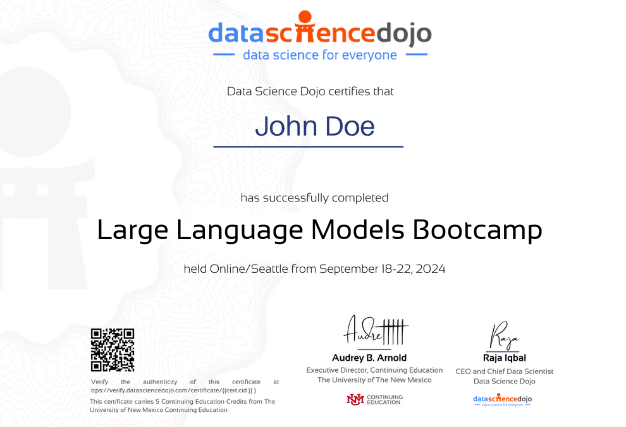
Earn a verified certificate
Earn a verified certificate from The University of New Mexico Continuing Education:
5 Continuing Education Credit (CEU)
Acceptable by employers for reimbursements
Valid for professional licensing renewal
Verifiable by The University of New Mexico Registrar’s office
Add to LinkedIn and share with your network
We accept tuition benefits
All of our programs are backed by a certificate from The University of New Mexico, Continuing Education. This means that you may be eligible to attend the bootcamp for FREE.
"Partnering with Data Science Dojo aligns with our mission to make data science accessible. Their bootcamps contribute to safe AI deployment education."
Alessya VisnjicCEO & Co-founder, WhyLabs
"LLM bootcamp provides exceptional, hands-on initiation into LLMs and practical applications. A deep dive into the subject with theoretical knowledge."
Jeff FongPrincipal Product Manager, HOVER Inc
"Six months of course material access post-training is valuable. Instructors ensure success, making it a top-notch learning experience in AI."
"Instructors simplified complex topics effectively. Hands-on learning enhanced my LLM understanding in 5 days. Intensive but immeasurable rewards."
Fatemeh Shah-MuhammadiResearch Assistant Professor, University of Utah School of Medicine
"A rewarding opportunity to help students of all backgrounds learn new techniques. Being part of a passionate data science community was a real privilege."
"LLM Bootcamp provides hands-on experience with expert instructors, a comprehensive framework, and extensive resources for substantial upskilling."
Bernard TumanjongChief, Operations Analysis, USA Air Force
"The effort in providing resources was commendable. Teachers and assistants were helpful, making it one of the best courses. I learned a lot for future use."
Fahad AlswainaSr. Data and Model Solutions Associate, KAPSARC
"Top-notch speakers, hands-on workshops, and networking make it a wonderful tech experience. Raja's in-depth teaching focuses on learning concepts."
Kevin SongSoftware Engineer, ICF
"Comprehensive curriculum in generative AI, prompt engineering, and data retrieval. Excited about practical training opportunities."
Taimur RashidAdvisor, Weaviate
"Collaborating with Data Science Dojo nurtures the next generation of LLM developers, commendable for fostering a dedicated creator community."
Harrison ChaseCo-Founder and CEO, LangChain
"This boot camp provided great content, equipping me with skills and confidence for efficient job execution. Enjoyable class and projects, a rewarding decision."
Luis Armando MSales and Services Manager, RAISA
"The LLM Bootcamp offered an enlightening, well-structured learning experience, invaluable networking, and insights into real-world AI challenges. "
Amity FoxData Scientist, 343 Industries
"Seamless navigation, invaluable hands-on exercises, and well-structured technical aspects for optimal, cost-effective results. Highly recommended for practical LLM knowledge."
Maryam Bagheri Designation-Senior Data Scientist, Deloitte Business
"Comprehensive curriculum for in-depth understanding, seamless hands-on learning with cloud-based tools, and insightful talks by industry experts. Highly recommended."
Jared MillerSoftware Development Manager, Gursey
"Outstanding boot camp, engaging discussions on coding and data security. A valuable and refreshing experience, recommended for advancing data science skills."
Kshitij SinghMachine Learning Lead, Trade Union
"Explored Data Science Dojo's LLM Bootcamp, gaining confidence with a comprehensive understanding. In-person experience, insightful instructors, and diverse insights."
Victor GreenDev-Ops Engineer, Victor Green Foundation
"LLM Bootcamp surpassed expectations, bridging theory with practical examples. Engaging with cohorts, invaluable insights, and balanced intensity elevated understanding. Highly recommended for language models."
Ken ButlerSolutions Architect, ICF
"LLM Bootcamp enriched my understanding of the language-tech intersection. Collaborating with peers was wonderful. Sophie DA's insightful presentation on practical applications is recommended for foundational knowledge."
Erika DavisSenior Business Reporting Analyst, Starbucks
"LLM Bootcamp shifted my problem-solving approach, sparking creativity with limitless applications. Highly recommended for anyone building their toolkit, fostering creativity in problem solvers, and providing invaluable insights for diverse applications."
Aishwariya RamanSenior Software Engineer, Microsoft
"Dedicated a week to a profound learning experience with Data Science Dojo, sparking innovative ideas. The practical approach revolutionized our models. Highly recommended."
David Martins GonclavesCo-founder CTO, Notify AI
"Engaging with diverse participants and the Dojo staff provided valuable insights. Emphasizes the importance of understanding model performance. Highly recommended for all roles."
Ed WileyAI Executive and Course Instructor, SteelHusk Innovations
"The bootcamp's blend of theory and hands-on experience suited learners of all backgrounds. In just five days, I gained invaluable knowledge and tools for navigating the AI landscape. "
Dave HortonVP Solutions Engineering, Odaseva
"The boot camp surpassed my expectations with insightful talks, practical insights, and comprehensive resources, essential for accelerating knowledge in LLMs."
Francisco MoralesSoftware Engineer, ICF
"The Data Science Dojo Bootcamp exceeded expectations, offering comprehensive learning, hands-on experience, and valuable insights, transforming my confidence in AI."
Sahar NesaeiData Scientist & ML Enthusiast, Lightcast
"The Bootcamp accelerated my text analysis skills by engaging in in-person experience, industry insights, and valuable hands-on learning. Highly recommended!"
Florian KlonekSenior Lecturer, Deakin University
"The Bootcamp helped me bridge the gap between academia and industry, offering insightful talks and practical problem-solving exercises. "
Yashwanth ReddyAI Leader, Fidelity Investments
"The Bootcamp exceeded my expectations, offering comprehensive training for both beginners and experienced data scientists. Highly recommended for all!"
Shakeeb SyedData Scientist, Nationwide
Frequently asked questions, answered.
I am from a non-technical background. Is the LLM bootcamp also for me?
Our LLM bootcamp has been attended by many individuals from non-technical backgrounds, including those in business consulting and strategy roles. The program is designed to make Generative AI concepts accessible, regardless of your technical expertise. You’ll gain practical insights into how LLMs are applied across industries, empowering you to advise clients better, lead AI initiatives, or collaborate effectively with technical teams.
Are there any prerequisites?
You need a very basic level of Python programming for our LLM bootcamp.
I don’t have a background in Python. Can I still join the LLM bootcamp?
Yes! We offer a short introductory course to help you get comfortable with Python. Plus, all code is provided in Jupyter Notebooks, so you’ll focus on understanding rather than writing code from scratch.
Where will the in-person session be held?
The address for the LLM bootcampvenue is given below:
Seattle Venue Address: Data Science Dojo5010 148th Ave NE, Redmond, WA 98052 [View on Map]
What is the duration of the bootcamp?
Our LLM bootcamp is an immersive five-day, 40-hour learning experience, available both in-person (Seattle) and online.
Are the online sessions live?
Yes, these sessions are live and are designed to be highly interactive.
Is the online instruction held at the same time as the in-person session, with the same instructors?
Yes, the online session will be held at the same time with the same instructors as the in-person session.
What does the LLM bootcamp include?
By joining the LLM bootcamp, you will receive:
40 hours of theory and hands-on learning
Live sessions with industry experts
1-year access to dedicated learner and coding sandboxes
LLM tokens, GPU clusters, and other required subscriptions
A verified certificate from the University of New Mexico upon completion
Is the program accredited?
Yes. You will receive a certificate from The University of New Mexico with 5 CEUs.
Will I get a Certificate after the completion of the bootcamp?
Yes, participants who complete the bootcamp will receive a certificate of completion in association with the University of Mexico. This certificate can be a valuable addition to your professional portfolio and demonstrate your expertise in building large language model applications.
What if I’m unable to attend a live session?
While we do not provide exact recordings of the live sessions, all key topics and content covered during the class are available in our companion courses. We’ve created structured lesson clips that reflect the material discussed, allowing you to review everything at your convenience even if you miss a live session.
Is the price for the online and in-person sessions different?
No, the price for the Large Language Models bootcamp will remain the same, regardless of whether you attend in person or online.
What is the refund policy?
If, for any reason, you decide to cancel, we will gladly refund your registration fee in full if you notify us at least five business days before the start of the training. We can also transfer your registration to another cohort if preferred.
However, refunds cannot be processed if you have transferred to a different cohort after registration. Additionally, once you have been added to the learning platform and have accessed the course materials, we are unable to issue a refund, as digital content access is considered program participation.
What is the transfer policy for the LLM bootcamp?
Transfers are allowed once with no penalty. Transfers requested more than once will incur a $200 processing fee.