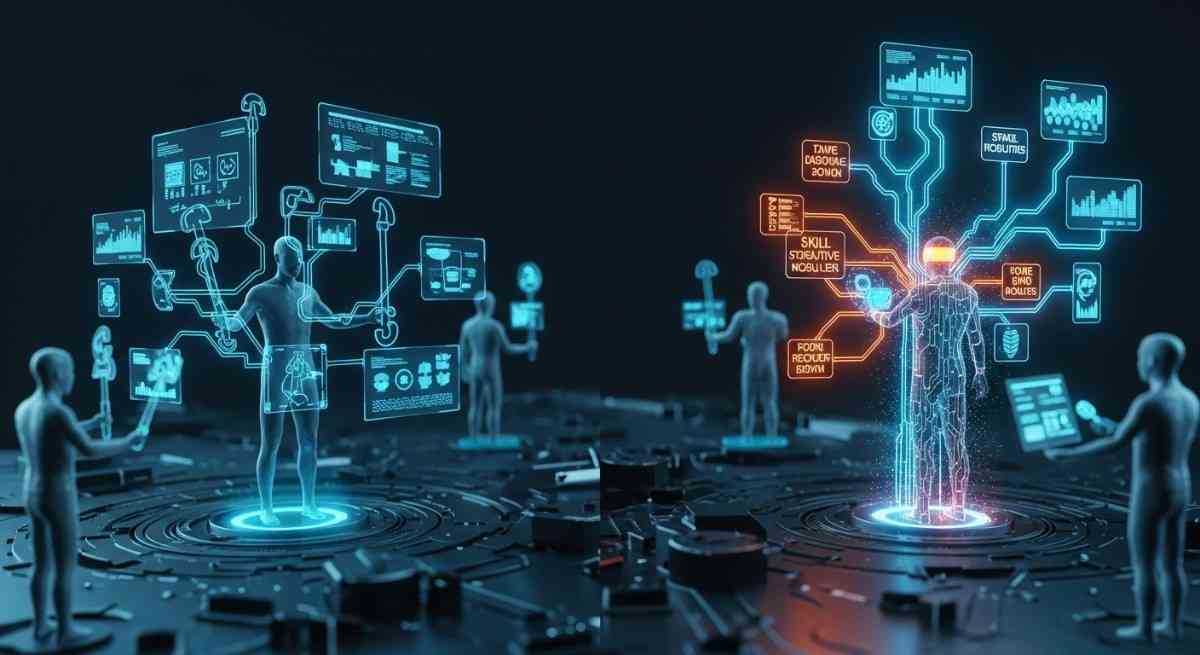
If you’ve spent any time building or even casually experimenting with agentic AI systems, tools are probably the first thing that come to mind. Over the past year, tools have gone from being a nice-to-have to the default abstraction for extending large language models beyond text. They are the reason agents can browse the web, query databases, run code, trigger workflows, and interact with real-world systems.
This shift didn’t happen quietly. It fundamentally changed how we think about language models. A model that can call tools is no longer just predicting the next token. It is orchestrating actions. It is deciding when it lacks information, when it needs to delegate work to an external system, and how to integrate the response back into its reasoning. Standards like Model Context Protocol (MCP) accelerated this shift by making tool definitions portable and structured, so agents could reliably talk to external capabilities without brittle prompt hacks.
But as tools matured, something interesting started happening in the background. People kept running into the same friction points, even with powerful tools at their disposal. Agents could do things, but they still struggled with how to think about doing them well. That gap is where agent skills enter the picture.
Rather than replacing tools, agent skills address a different layer of the problem entirely. They focus on reasoning patterns, reusable cognitive workflows, and behavioral structure—things that tools were never designed to handle.
From Tools to Thinking Patterns
To see why agent skills were even needed, it helps to look at how most agents were being built before the concept existed. A typical setup looked something like this: a system prompt describing the agent’s role, a list of available tools, and a large blob of instructions explaining how the agent should approach problems.
Over time, those instruction blocks grew longer and more complex. Developers added planning steps, verification loops, fallback strategies, and safety checks. Entire mini-algorithms were embedded directly into prompts. If you’ve ever copied a carefully tuned “reasoning scaffold” from one project to another, you’ve already felt this pain.
The problem was not that this approach didn’t work. It did. The problem was that it didn’t scale.
Every new agent reimplemented the same patterns. Every update required editing massive prompts. Small inconsistencies crept in, and behavior diverged across agents that were supposed to be doing the same thing. Tools solved external capability reuse, but there was no equivalent abstraction for internal reasoning reuse.
This is exactly the class of problems agent skills were designed to solve.
The Introduction of Agent Skills by Anthropic
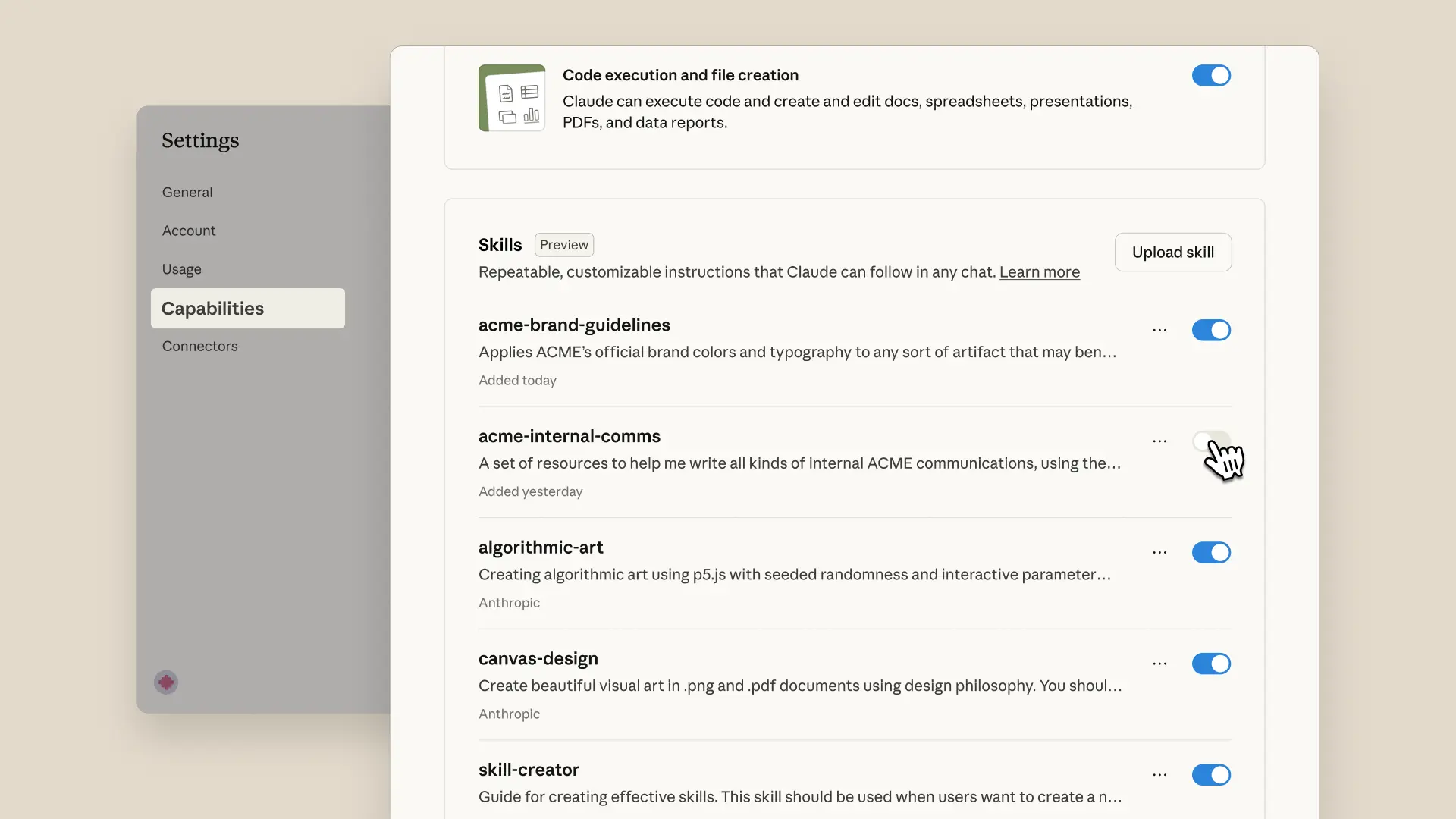
source: Anthropic
Anthropic formally introduced agent skills on October 16, 2025, as part of their broader work on making Claude more modular, composable, and agent-friendly. The timing was not accidental. By then, it was clear that serious agent builders were no longer asking, “Can my model call tools?” They were asking, “How do I make my agent reliable, consistent, and reusable across contexts?”
Agent skills reframed agent development around reusable cognitive components. Instead of embedding reasoning logic directly into every prompt, you could define a skill once and attach it to any agent that needed that capability. This marked a shift in how agents were written, tested, and evolved over time.
Importantly, agent skills were not positioned as a replacement for tools. They were introduced as a complementary abstraction—one that sits between raw prompting and external tool execution.
Why Tools and Agent Skills Are Fundamentally Different
At a conceptual level, the difference between tools and agent skills comes down to where they operate.
Tools operate outside the model. They are external functions or services that the model can invoke. Their inputs and outputs are structured, and their behavior is deterministic from the model’s perspective. When a tool is called, the model pauses, waits for the result, and then continues reasoning.
Agent skills, on the other hand, operate inside the model’s reasoning loop. They shape how the agent plans, evaluates, and makes decisions. They do not fetch new information from the world. Instead, they constrain and guide the model’s internal process.
You can think of the distinction like this:
Tools extend capability
Agent skills extend competence
A tool lets an agent access a database. An agent skill teaches the agent how to decide when to query, what to query for, and how to validate the result.
This difference is subtle, but once you see it, you can’t unsee it.
The Core Problem Agent Skills Solve
At its core, the problem agent skills solve is not about capability, but about structure. Modern agents are already powerful. They can reason, call tools, and generate complex outputs. What they lack is a consistent, reusable way to apply that reasoning across different contexts, agents, and products.
Without agent skills, every agent becomes a bespoke construction. Two agents designed to do “research” might both work, but each will interpret planning, verification, and decision-making slightly differently. These differences are not always obvious, but they accumulate. Over time, systems become harder to reason about, harder to maintain, and harder to trust.
Most teams try to solve this by writing longer and longer prompts. Planning logic, fallback strategies, validation steps, and domain-specific heuristics all get embedded directly into system instructions. This works in the short term, but it creates a fragile setup where reasoning patterns are duplicated, inconsistently updated, and difficult to audit.
To make this more concrete, consider a research agent tasked with answering technical questions. Ideally, you want the agent to:
Decompose the question into smaller, answerable sub-questions
Decide which sub-questions require external data
Use tools selectively rather than reflexively
Cross-check information before synthesizing a final response
You can describe all of this in a prompt, and the agent will likely follow it. But now imagine you need ten such agents: one for infrastructure research, one for ML papers, one for internal documentation, one for customer questions, and so on. You are faced with an uncomfortable choice. Either you duplicate this logic across ten prompts, or you allow each agent to drift into its own interpretation of what “good research” means.
Agent skills exist to eliminate this tradeoff.
They allow reasoning patterns like this to be encoded once and reused everywhere. Instead of being informal prompt conventions, these patterns become explicit, named capabilities that can be attached to any agent that needs them. The result is not just less duplication, but more consistency across the entire agent system.
More broadly, agent skills address several systemic issues that tools alone cannot solve.
Reasoning Needs Context, Not Just Actions
Tools give agents the ability to execute actions, but they don’t explain how those actions should fit into a broader workflow. Agent skills provide the missing context that tells an agent when to act, when to wait, and when not to act at all. This includes organizational conventions, domain norms, and user-specific expectations that are difficult to encode as APIs but essential for reliable behaviour.
Loading Only What the Agent Actually Needs
One of the quiet failure modes of agent systems is context overload. When every instruction is always present, agents waste attention on information that may not be relevant to the current task. Agent skills allow reasoning guidance to be introduced incrementally—high-level intent first, detailed procedures only when necessary—keeping the model focused and efficient.
Build Once, Use Everywhere
Without agent skills, reasoning logic tends to be rewritten for every new agent. With skills, that logic becomes portable. A planning or evaluation strategy can be defined once and reused across agents, products, and domains. This mirrors how software engineering moved from copy-pasted code to shared libraries but applied to reasoning instead of execution.
Turning Expertise into a First-Class Artifact
As agents move into specialized domains, raw intelligence is no longer enough. They need structured domain knowledge and conventions. Agent skills provide a way to encode this expertise—whether legal reasoning, data workflows, or operational playbooks—into versioned, reviewable artifacts that teams can share and improve over time.
Reasoning You Can Actually Read and Review
A subtle advantage of agent skills is that they are designed to be human-readable. Defined in clear Markdown, they double as documentation and behavior specification. This makes them easier to audit, discuss, and refine, especially in contrast to tools whose behavior is often buried deep in code.
What Is a Skill in Claude, Exactly?
In the Claude ecosystem, a skill is a structured definition of a reusable reasoning capability. It tells the model how to behave in certain situations, what constraints to respect, and how to structure its internal thinking.
A skill is not executable code in the traditional sense. It does not run outside the model. Instead, it is consumed by the model as part of its context, much like system instructions, but with clearer boundaries and intent.
Agent skills are designed to be:
Reusable across agents
Explicitly named and scoped
Easier to version and update
This alone dramatically improves maintainability in complex agent systems.
Files Required to Define a Claude Skill
Claude skills are defined as small, self-contained packages that describe a reusable reasoning capability. While the exact structure may evolve over time, the underlying idea is intentionally simple: a skill should clearly explain what it does, when it applies, and how the agent should reason while using it.
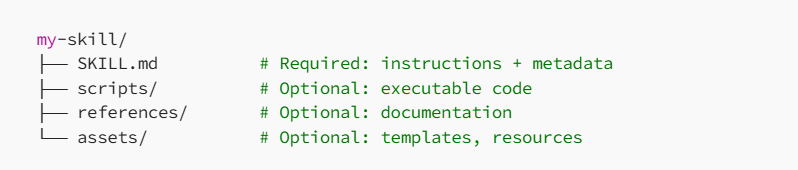
At minimum, a Claude skill is centered around a skill.md file. This file acts as both documentation and instruction. It is written in natural language but structured carefully enough that the model can reliably internalize and apply it.
Optional metadata used by the agent runtime to register the skill
source: Akshay Kokane
The design mirrors how humans already document best practices. Instead of encoding reasoning implicitly inside prompts or code, the logic is surfaced explicitly as a reusable artifact.
Example of a skill.md File
Imagine a skill designed to help an agent perform careful, multi-step analysis. A simplified version of a skill.md file might describe:
The goal of producing structured, verifiable reasoning
An expectation that assumptions are explicitly stated
A requirement to validate conclusions before responding
The power here is not in the syntax, but in the consistency. Every agent using this skill will approach problems in roughly the same way, even across very different tasks.
This is where agent skills start to feel less like prompts and more like architectural components.
How Claude Calls and Uses Agent Skills
From the agent’s perspective, using agent skills is straightforward. Skills are attached to the agent at configuration time, much like tools. Once attached, the model can implicitly apply the skill whenever relevant.
There is no explicit “call” in the same sense as a tool invocation. Instead, the skill shapes the agent’s reasoning continuously. This is an important distinction. Tools are discrete actions. Agent skills are persistent influences.
Because of this, multiple agent skills can coexist within a single agent. One skill might govern planning behavior, another might enforce safety constraints, and a third might specialize the agent for a particular domain.
Why Agent Skills and Tools Are Not Interchangeable
It can be tempting to ask whether agent skills could simply be implemented as tools. In practice, this approach quickly breaks down.
Tools are reactive. They wait to be called. Agent skills are proactive. They influence how decisions are made before any tool is invoked.
If you tried to implement a planning skill as a tool, the agent would still need to know when to call it and how to apply its output. That logic would live elsewhere, defeating the purpose.
This is why agent skills and tools are not interchangeable abstractions. They live at different layers of the agent stack and solve different problems.
The real power emerges when agent skills and tools are used together. A well-designed agent might rely on:
Agent skills to structure reasoning and decision-making
Tools to perform external actions and data retrieval
For example, a skill might enforce a rule that all external information must be cross-checked. The tools then provide the mechanisms to fetch that information. Each does what it is best at.
This layered approach leads to agents that are more reliable, more interpretable, and easier to evolve over time.
Why Agent Skills Matter Going Forward
As agentic systems continue to grow in complexity, the need for modular reasoning abstractions will only increase. Tools solved the problem of external capability reuse. Agent skills address the equally important problem of internal behavior reuse.
If tools were the moment agents learned to act, agent skills are the moment they started to think consistently.
And that shift, subtle as it may seem, is likely to define the next phase of agent design.
Ready to build robust and scalable LLM Applications? Explore Data Science Dojo’s LLM Bootcamp and Agentic AI Bootcamp for hands-on training in building production-grade retrieval-augmented and agentic AI
Subscribe to our newsletter
Monthly curated AI content, Data Science Dojo updates, and more.