
Key Takeaways
- RBAC vs ReBAC is not just a technical choice — it directly determines which enterprise sales cycles your AI platform can survive. 46% of enterprise software buyers select vendors based on security certifications (Gartner Digital Markets, 2024)
- Gartner predicts 40% of enterprise applications will feature task-specific AI agents by end of 2026, up from less than 5% in 2025. Authorization architecture decisions made today will either support or constrain that growth (Gartner, August 2025)
- 80% of Fortune 500 companies already have active AI agents in production (Microsoft, February 2026), but 47% of AI-deploying organizations have no AI-specific security controls (BigID, June 2025)
- ReBAC eliminates role explosion — the core scaling failure of RBAC in agentic systems — by expressing permissions through relationships rather than explicit role combinations
Authorization Architecture for Enterprise AI: The Case for Relationship-Based Access Control
As AI platforms move from single-model tools to multi-agent systems, the authorization requirements change in ways that matter to enterprise buyers. This post covers what changes, why it matters commercially, and what the architectural response looks like.Why RBAC vs ReBAC Is the Defining Access Control Question for Enterprise AI in 2026
Enterprise software has a long tradition of treating security infrastructure as something you build after the product works. Get the core experience right, prove demand, then harden. For most of software history, this sequencing was defensible. The systems being built were bounded enough that authorization could be layered in without fundamentally rearchitecting anything.Agentic AI platforms change this calculus. When AI agents act autonomously on behalf of users, traverse organizational knowledge, and execute decisions across systems and tenants, the question of what each actor is authorized to access becomes inseparable from the product itself. Authorization is no longer infrastructure that sits around the system. It becomes part of the system’s execution model.
At https://ejento.ai/">Ejento AI, building an agentic AI platform for enterprise deployments made this concrete early. Working through the authorization requirements for a multi-tenant, multi-agent environment kept surfacing the same structural problem: the permission model wasn’t designed to represent the relationships that actually governed access in the system. The decision to invest in a relationship-based approach came from that realization, not from theory. Authorization decisions that look like infrastructure choices are also product decisions. They shape what the platform can be trusted to do, and which customers can deploy it with confidence.
The questions that come up consistently in enterprise deployments aren’t abstract: how does access propagate when organizational structure changes? How is tenant isolation enforced across shared infrastructure, not just asserted? How is the access model verified rather than reconstructed from application code? These are the questions a well-designed authorization system should answer directly. They’re also the questions that determine whether a platform advances through enterprise security review.
Where Traditional RBAC Authorization Falls Short for Agentic AI
Enterprises now manage an average of 45 non-human identities per human employee, according to the Cloud Security Alliance's RSAC 2025 report. Traditional access control was designed for a human logging in, checking permissions, and acting. AI agents challenge every assumption in that model. As the Cloud Security Alliance puts it: "Traditional identity management systems fall short in the dynamic world of AI agents"The first specific requirement is agent identity. An AI agent may initiate, continue, and complete workflows autonomously, without the originating user directing each step. Agents are not service accounts: unlike a service account whose permissions are static, an agent’s effective scope may shift within a single workflow as it moves from retrieval to action. A system that conflates agent access with user access faces two bad options: grant broader access than any individual action requires, or restrict agents enough to impede the workflow. Neither works in a production enterprise environment.
The second requirement is organizational hierarchy. Enterprise deployments don’t serve a flat user base against a flat set of resources. They serve organizations with internal structure: teams, divisions, projects, shared knowledge repositories, each representing an authorization boundary that must be respected independently and consistently. A permission model that can’t represent this structure natively pushes the complexity into application code. It accumulates there silently, inconsistently, and at increasing cost to audit.
These aren’t edge cases. They’re the baseline requirements for any AI platform operating at enterprise scale.
RBAC for AI Agents: Strengths and Scaling Constraints
Role-Based Access Control (RBAC) has been the enterprise standard for good reason. It's well-understood, widely supported, and works reliably in systems with a stable user population, a predictable set of resource types, and a manageable number of permission combinations. That describes most enterprise software built over the past two decades.Agentic AI platforms tend to push on all three constraints at once. They do this faster than most enterprise systems because agents introduce additional dimensions to the access policy problem. Permissions are no longer defined only by who a user is, but also by what an agent is allowed to do, what data it can access, and how that access should change as a workflow progresses. Capability types, workflow states, and action scopes all become part of the authorization decision.
https://nvlpubs.nist.gov/nistpubs/specialpublications/nist.sp.800-162.pdf">NIST SP 800-162 identifies “role explosion” as a common outcome when RBAC is applied to systems with fine-grained, multi-dimensional access requirements. (NIST SP 800-162). The underlying dynamic is straightforward. As systems combine more variables such as resource types, permission levels, and operational context, the number of roles required to represent valid access patterns grows quickly if each combination is modeled explicitly. For example, consider an agentic platform with multiple agent types, several workflow stages, and different categories of knowledge bases. If access needs to be defined separately for each combination, a small initial set of roles can expand into dozens or hundreds of context-specific variants over time.
In workflows requiring access to various data types, an agent may need general documentation at one step and a restricted internal dataset in another. In an RBAC system, this necessitates predefined roles or additional logic to manage permissions, which can lead to coordination issues and excessive access. Conversely, a relationship-based model allows for direct expression of permissions through the relationships among the agent, resources, and context, enabling consistent permission derivation without explicit combinations.
Bar chart showing RBAC role counts multiplying from a small baseline to a large set as agent types, workflow states, and resource categories are introduced.
There is also an audit dimension. In systems with role hierarchies and cross-system permissions, answering "who has effective access to this resource right now?" typically requires combining role assignments with resource context and application logic. NIST SP 800-162 notes that demonstrating compliance under RBAC can be "difficult and costly" for this reason. (NIST SP 800-162). The challenge is not that RBAC cannot represent these scenarios, but that it does not express them directly, which makes the system harder to reason about as complexity increases.
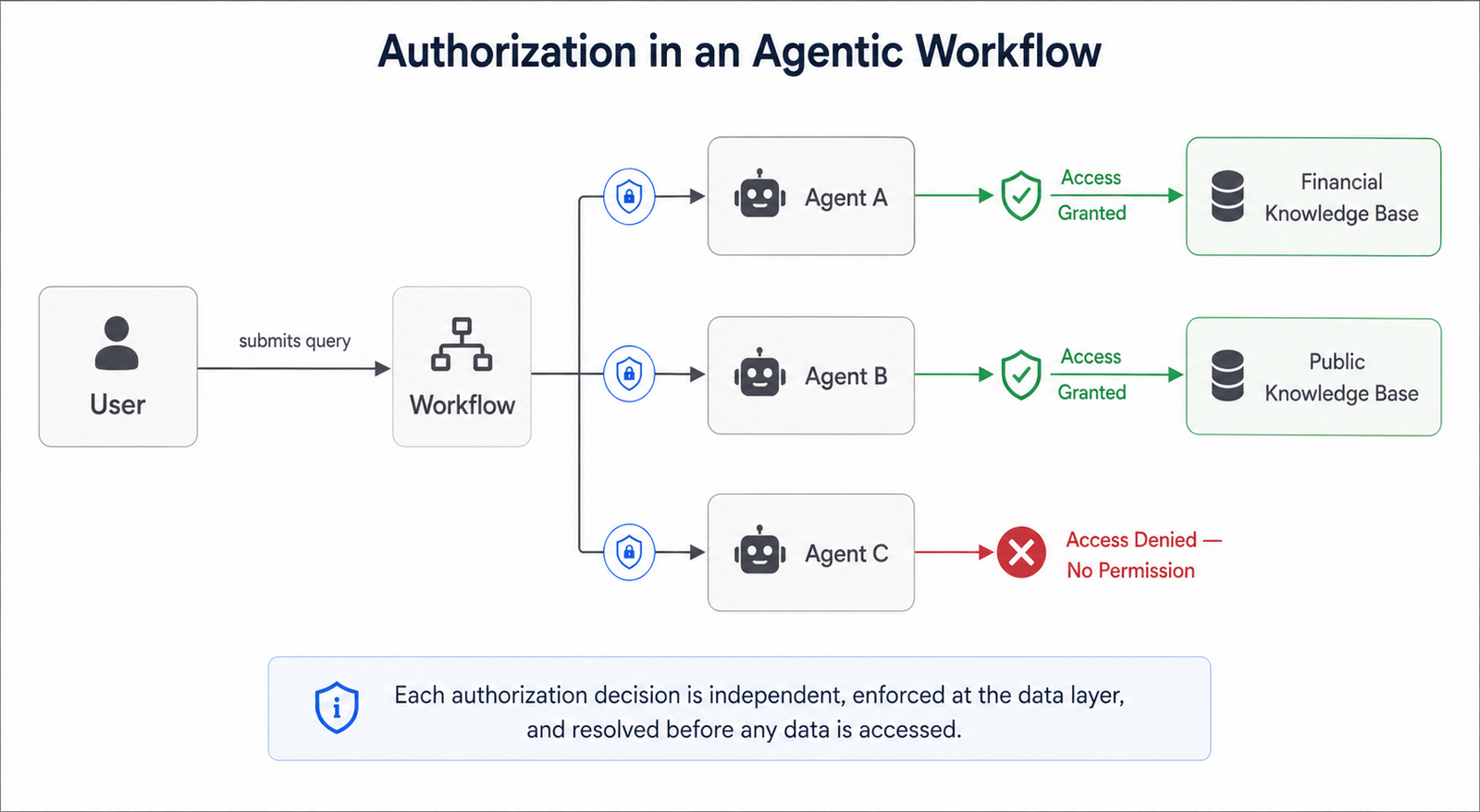
ReBAC Explained: How Relationship-Based Access Control Works for Enterprise AI
ReBAC (Relationship-Based Access Control) derives permissions from the relationships between entities rather than from explicit role assignments. Access is determined by traversing a graph from the requesting actor to the target resource. This architectural shift addresses role explosion at its root, and makes organizational changes propagate automatically through the permission model.For business readers, the practical difference comes down to what the system knows natively. An RBAC system knows which roles a user holds. A ReBAC system knows how that user relates to every resource in the system, directly and indirectly. That distinction matters most when things change.
| What changes | RBAC | ReBAC |
|---|---|---|
| New resource type added | New roles for every context combination | Schema extension inherits existing model |
| Audit: who has access to X? | Reconstruct from role tables and application logic | Direct graph query — precise and current |
| AI agent scope | No native bounded agent concept | Agent is a first-class entity with defined scope |
Auditability becomes a native operation. “Who has access to this resource, and through what path?” is answered by a graph query rather than reconstructed from role tables. In 2019, Google published the Zanzibar paper at USENIX, documenting the authorization system that governs access across Google Drive, YouTube, Photos, and Cloud. It manages more than two trillion access control lists, with availability greater than 99.999% over three years https://research.google/pubs/zanzibar-googles-consistent-global-authorization-system/">(Pang et al., USENIX ATC 2019). The graph-based model isn’t a theory. It’s what one of the most demanding authorization workloads at global scale actually runs on.
RBAC requires explicit grants per resource. ReBAC propagates access through relationships automatically.
RBAC vs ReBAC: Side-by-Side Comparison for Enterprise AI Deployments
The table below summarizes the key differences when evaluating RBAC vs ReBAC specifically for agentic enterprise AI platforms.| Criteria | RBAC | ReBAC |
|---|---|---|
| Permission model | Role assignments | Entity relationships |
| AI agent identity | No native concept | First-class entity |
| Multi-tenant isolation | Requires application logic | Enforced through graph structure |
| Role explosion risk | High as system scales | Eliminated by design |
| Audit query | Requires reconstruction | Native graph query |
| Org structure changes | Manual role updates | Auto-propagates through relationships |
| SOC 2 / ISO 27001 readiness | Harder to demonstrate | Directly queryable and demonstrable |
| Best for | Stable, bounded systems | Dynamic, multi-agent, enterprise AI |
The Implementation Landscape: OpenFGA, SpiceDB, and Permify
The Zanzibar model is an open architecture, not a proprietary one. Open-source ReBAC implementations — SpiceDB, OpenFGA, and Permify among them — provide production-ready infrastructure for engineering teams building on the model. The choice between available implementations is an engineering decision based on your specific requirements and operational environment. The relevant point for this discussion: the tooling is mature, the architecture is proven at scale, and the decision to adopt the model is an architectural choice, not a research project.RBAC vs ReBAC in Enterprise Security Review: What Buyers Actually Ask
Enterprise procurement for AI platforms now routinely includes AI agent security reviews that ask specific questions about access control. According to Gartner Digital Markets, 46% of enterprise software buyers select a vendor specifically because of security certifications and data privacy practices. A platform that can't answer access control questions with specificity typically doesn't advance through security review, regardless of its functional capabilities.Enterprise security reviews for AI platforms follow a predictable pattern. The questions are specific:
- Who has access to this knowledge base, and through what path?
- Can you demonstrate that an AI agent scoped to one organization cannot access another's data?
- Can you show the access model, not just describe your policies?
SOC 2 Type II certification, ISO 27001 compliance, and pre-contract vendor questionnaires all ask the same kind of questions. These are threshold requirements, not preference questions.
Authorization architecture is what makes certifications like SOC 2 Type II and ISO 27001 achievable and demonstrable. With https://www.prnewswire.com/news-releases/new-study-reveals-major-gap-between-enterprise-ai-adoption-and-security-readiness-302469214.html">47% of AI-deploying organizations currently operating without AI-specific security controls, platforms that have invested in this have a clear advantage in enterprise evaluations.
As the enterprise AI market matures, authorization architecture is increasingly separating platforms that can be evaluated from those that can’t. The competitive advantage compounds: every deal that advances through security review reinforces a pattern. Every deal that stalls there creates a remediation problem that grows with the product.
Why Choosing Between RBAC and ReBAC Early Is a Strategic Business Decision
The timing of the architectural investment matters as much as the investment itself. Authorization architecture is exceptionally difficult to retrofit. The patterns by which a system represents resources, relationships, and access decisions are foundational. They're referenced throughout the codebase, embedded in API contracts, and coupled to data models. The right time to invest is before your first enterprise sales cycle that includes a security review. The wrong time is under sales pressure with customer data already at rest. For a broader look at how enterprise AI projects succeed or stall, see AI for Enterprise: The 3-Stage Agentic AI ROI Model.Risk Reduction
A least-privilege model enforced at the authorization layer reduces the blast radius when any component is compromised. For platforms handling enterprise data, this is a liability position, not just an engineering preference.Enterprise Sales Velocity
Every sales cycle that stalls in security review represents revenue deferred. Every deal that requires a custom security assessment, because the platform can't answer standard access control questions, costs time and deal momentum. The teams that handle this well invest in authorization architecture ahead of enterprise demand. That's not a cost. It's a reduction in the friction that enterprise sales cycles impose on revenue.Product Scalability
A correctly designed authorization layer is infrastructure that new capabilities inherit rather than work around. Each new agent capability, data connector, or resource type can extend the schema rather than require new permission logic to be written, tested, and audited separately.Authorization Is the Trust Layer
Authorization architecture is an organizational trust question, not just a technical one. Enterprises deploying agentic AI platforms aren't making a procurement decision in isolation. They're deciding whether to trust a platform with sensitive data, proprietary knowledge, and operational processes their businesses depend on.That trust decision is made and remade continuously. Every time an administrator needs to understand who has access to what. Every time an access change needs to take immediate effect. Every time a security review asks whether the platform can demonstrate compliance with its stated access controls.
Platforms that establish this infrastructure early, before the enterprise sales cycles that demand it, build something more durable than any individual feature. They create the conditions under which enterprise-grade AI — agents, workflows, and all — can be deployed with confidence. That’s the market they’re competing for.
Frequently Asked Questions
What is the main difference between RBAC and ReBAC for AI agents?
RBAC assigns permissions based on a user's role — a static label. ReBAC assigns permissions based on relationships between entities in the system. For AI agents, RBAC creates "role explosion" as agents move through different workflow states. ReBAC avoids this by letting the agent's graph relationships define what it can access at each step — without pre-defining every combination.When should an enterprise AI platform use ReBAC instead of RBAC?
ReBAC becomes necessary when your system has multi-tenant isolation requirements, dynamic agent workflows, or fine-grained access at the resource level. If your AI agents operate across organizational hierarchies or need least-privilege enforcement at each workflow step, RBAC alone will not scale. ReBAC is the stronger choice for any enterprise AI platform heading into a SOC 2 or ISO 27001 review.Is authorization architecture primarily a security concern or a business concern?
Both, and they're inseparable at enterprise scale. The security dimension is straightforward: a well-designed authorization layer enforces least-privilege access, reduces blast radius, and makes compliance demonstrable rather than asserted. The business dimension is equally important: authorization architecture directly determines which enterprise sales cycles advance and which stall. Platforms that can answer access control questions with precision move through security review on their merits. Those that cannot are filtered out before their merits are reached.What is the commercial cost of getting authorization architecture wrong?
The direct cost is deals lost in security review and deployments delayed by access management limitations. The less visible cost compounds over time: a platform built on an inadequate authorization model accumulates permission logic across its codebase as it grows, and each new capability makes the eventual migration more expensive. Platforms that build this correctly early operate with a structural advantage in enterprise evaluations that only grows as the product scales.When does authorization architecture become load-bearing for enterprise AI platforms?
Earlier than most teams expect. Specifically, at the first enterprise sales cycle that includes a security review. Authorization architecture is foundational and closely coupled to data models and API contracts. Retrofitting it after a product is in production is a different category of effort than building it correctly from the start. The teams that reach enterprise demand with this foundation already in place don't face this problem. The ones that don't, face it under the worst possible conditions.What are the best open-source ReBAC implementations?
The three most production-ready open-source ReBAC implementations are OpenFGA (a CNCF project originally developed by Okta), SpiceDB (by Authzed), and Permify. All three are based on Google's Zanzibar model. OpenFGA is the most widely adopted for B2B SaaS and enterprise AI use case.About The Author
Hunain Imran is a software engineer at Ejento AI, where he works on authorization and access control for an agentic AI platform built for enterprise deployments. The perspective in this post comes from that work — designing systems where the question of who has access to what is answered by architecture, not by code scattered across services.Want to build AI agents that can reason, plan, and execute autonomously?
Learn more