Kimi K3 vs Claude Fable 5: How Moonshot's open-weight model stacks up against Claude
Kimi K3 just topped Frontend Code Arena and scores 57 on the Intelligence Index vs Claude Fable 5's 60. See how the two compare.
DS
Data Science Dojo Staff · 8 min read
Key takeaways:
Kimi K3 is live now on the Kimi apps, Kimi Work, Kimi Code, and the Kimi API, and it just took the number one spot on Frontend Code Arena ahead of Claude Fable 5, the first time an open-weight model has led that leaderboard.
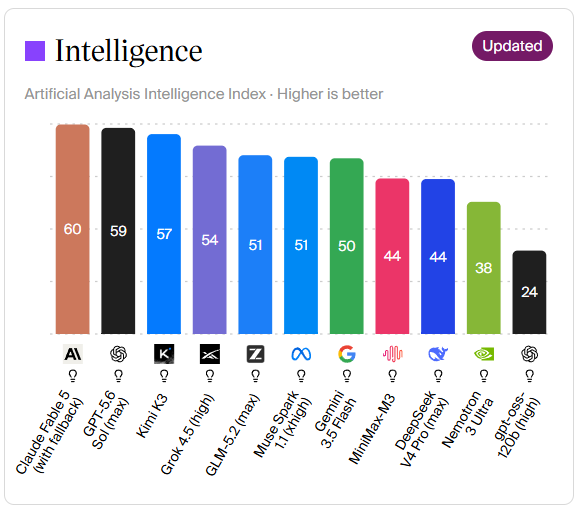
On the Artificial Analysis Intelligence Index, Kimi K3 scores 57 against Claude Fable 5’s 60, GPT-5.6’s 59, and Claude Opus 4.8’s 56, close enough to make the choice between an open and closed model a real trade-off rather than an easy call.
Full open weights (an estimated 2.8 trillion parameters) and a technical report are due July 27, 2026, alongside a new attention mechanism called Kimi Delta Attention that Moonshot claims makes long-context inference up to six times cheaper.
Moonshot AI released Kimi K3 this week, and it is already the first open-weight model to lead the Frontend Code Arena leaderboard. The model went live on the Kimi apps, Kimi Work, Kimi Code, and the Kimi API, running by default at “max/extreme” reasoning intensity.
For developers who have spent the past few months watching Claude Fable 5 (since updated to Fable 5.1) and GPT-5.6 trade the top spots on intelligence benchmarks, Kimi K3’s scores are close enough to force an actual decision: pay for a closed frontier model, or run an open-weight one that lands within a few points of it.
This post breaks down where Kimi K3 beats Claude Fable 5, where it falls short, and what its new attention mechanism means for teams evaluating both models for coding-heavy work.
What Moonshot AI Shipped, and When
Kimi K3 is available across Moonshot’s full product surface, not just as an API endpoint. That matters for practitioners who want to test the model inside an existing workflow before committing engineering time to a self-hosted deployment.
Available now: kimi.com, the Kimi consumer apps, Kimi Work, Kimi Code, and the Kimi API
Default reasoning setting: “max/extreme,” meaning the model runs its most thorough reasoning mode out of the box rather than a lighter default
Open weights and technical report: planned for July 27, 2026
Estimated parameter count: roughly 2.8 trillion, based on community estimates ahead of the technical report, not a figure Moonshot has confirmed
This is Moonshot’s third major release in the Kimi line. We covered the architecture and agentic capabilities of the previous generation in our deep dive into Kimi K2, and the jump in benchmark performance from K2 to K3 gives a useful baseline for how fast Moonshot is iterating.
Kimi K3 vs Claude Fable 5 on the Benchmarks That Matter
Raw intelligence scores tell you how a model reasons in general. Coding and frontend benchmarks tell you how it performs on the tasks. Kimi K3’s story looks different depending on which lens you use.
Benchmark
Kimi K3
Claude Fable 5
GPT-5.6
Claude Opus 4.8
Artificial Analysis Intelligence Index
57
60
59
56
Coding Agent Index
57
59
61
55
Frontend Code Arena
1,679 (#1)
1,631
1,618 (Sol)
–
On the Coding Agent Index specifically, Kimi K3 matches GPT-5.6 Terra and GPT-5.5 at a score of 57 and edges ahead of Claude Opus 4.8. That score is built from a mix of underlying tests: 84% on Terminal-Bench v2, 64% on DeepSWE, and 23% on SWE-Atlas-QnA. The DeepSWE result is worth pausing on. Kimi K3 debuted at #3 on that leaderboard, the first open-weight model to post a frontier-level result there.
source: Artificial Intelligence Index
That earlier comparison between Kimi K2.6 and Claude Sonnet 4.6 tested the previous Kimi generation against a Claude model head to head on real development tasks, and it is the closest reference point for how much ground Moonshot has closed with K3. The pattern holds: Kimi keeps closing the gap on coding-specific benchmarks faster than it closes the gap on general intelligence.
Kimi Delta Attention: Why Moonshot Says Kimi K3 Is Cheaper at Long Context
The architectural change behind Kimi K3 is called Kimi Delta Attention, or KDA. Standard attention mechanisms pay a cost that scales with the full length of the context window, so a 1 million token prompt gets proportionally more expensive to process than a 10,000 token one. KDA instead maintains a fixed-size, learned per-request state, closer to a fast-weights approach than traditional full attention.
Moonshot claims this delivers up to six times faster and cheaper throughput at 1 million token context, with a flatter pricing curve as context grows. For teams running agentic workflows that accumulate long conversation histories or ingest large codebases in a single session, that pricing shape is the more interesting claim than the headline benchmark scores. It changes the calculus for when long-context usage becomes economically painful.
The Cost Efficiency Debate
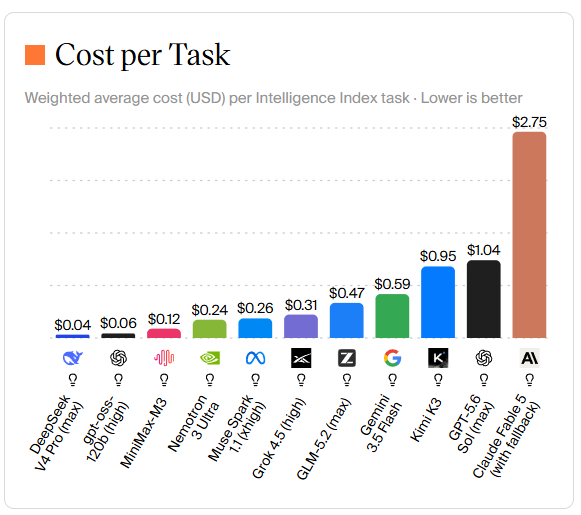
Not every analyst agrees on how efficient Kimi K3 actually is in practice. Artificial Analysis has called the model frontier-efficient based on its benchmark-to-cost ratio.
source: Artificial Intelligence Index
Other analysts estimate that Kimi K3 uses roughly twice the tokens of GPT-5.6 Sol to complete the same task, which can erase the headline price advantage once you account for total tokens billed rather than price per token alone.
This is a familiar tension in the open-weight world: a lower list price does not automatically mean a lower total bill. We laid out the broader version of this trade-off in our piece on the cost and control trade-offs between open-source and closed-source LLMs, and Kimi K3 is a live example of it. Before switching a production workload to K3 on cost grounds alone, run your own token-count comparison on representative tasks rather than trusting the sticker price.
Running Kimi K3 Yourself: Deployment Status
Self-hosting is still early. The community is already testing Kimi K3 on 4xH100 nodes over RoCE networking, and support for vLLM and AMD hardware is in progress but not finished. Teams that want to run K3 in their own infrastructure today should expect to do some integration work rather than pull a ready-made deployment recipe.
That will change once the full open weights land on July 27. A published technical report typically comes with reference deployment configurations, which should shorten the path from “we tested it on kimi.com” to “we’re running it in production.”
Kimi K3 vs Claude Fable 5: Which Should You Actually Use
The honest answer depends on what you are building. For frontend-heavy agentic coding, Kimi K3’s lead on Frontend Code Arena is a real signal worth testing against your own UI generation tasks. For general reasoning and tasks that lean on broad intelligence rather than code generation specifically, Claude Fable 5’s higher Intelligence Index score suggests it still has an edge. If your team already has a Claude Code workflow built around Anthropic’s current model lineup, switching a single workload to Kimi K3 for a head-to-head test costs less than migrating an entire pipeline.
Whichever model you evaluate, read benchmark scores as a starting point rather than a final verdict. We cover how to interpret and stress-test these numbers yourself in our guide to the LLM benchmarks worth knowing, which is useful context before you take any single leaderboard score at face value.
What to Watch Next
Three things will clarify the picture over the next two weeks. The July 27 open-weight release and technical report will let independent teams verify the parameter count and reproduce the benchmark numbers outside Moonshot’s own testing. Progress on vLLM and AMD support will determine how quickly self-hosted deployments become practical outside of H100 clusters. And on the competitive side, Google’s Gemini 3.5 Pro reportedly slipped its expected July 17 launch after falling short on coding and reasoning tests internally, with no official model card or pricing published yet. That gap in the closed-model release calendar gives Kimi K3 a longer runway to establish itself before the next major closed-model entry arrives.
Frequently Asked Questions
What is Kimi K3?
Kimi K3 is Moonshot AI’s newest large language model, live now on kimi.com, the Kimi apps, Kimi Work, Kimi Code, and the Kimi API. It runs with “max/extreme” reasoning intensity by default and scores 57 on the Artificial Analysis Intelligence Index.
Is Kimi K3 open source?
Partially, as of this week. The model is live for use through Moonshot’s products and API now, but the full open weights and an accompanying technical report are scheduled for July 27, 2026. Community estimates put the parameter count around 2.8 trillion, though Moonshot has not confirmed that figure.
How does Kimi K3 compare to Claude Fable 5 on coding tasks?
Kimi K3 leads Claude Fable 5 on Frontend Code Arena, 1,679 to 1,631, and matches GPT-5.6 on the Coding Agent Index at a score of 57. Claude Fable 5 still leads on the broader Artificial Analysis Intelligence Index, 60 to 57.
What is Kimi Delta Attention?
Kimi Delta Attention, or KDA, is the attention mechanism behind Kimi K3. It maintains a fixed-size, learned per-request state instead of scaling attention cost with the full context length, which Moonshot claims delivers up to six times faster and cheaper throughput at 1 million token context.
Can I run Kimi K3 myself?
Yes, in early form. The community is already testing it on 4xH100 nodes over RoCE, and vLLM plus AMD support is in progress. Full self-hosting will be more straightforward once the open weights and technical report ship on July 27.
Is Kimi K3 actually cheaper to run than closed models?
It depends on the task. Artificial Analysis rates it as frontier-efficient, but some analysts estimate it uses roughly twice the tokens of GPT-5.6 Sol per task, which can offset the lower per-token price. Test token counts on your own workloads before assuming a cost advantage.
Want to build AI agents that can reason, plan, and execute autonomously?