
For years, data engineering had a clear mission: move data, clean it, transform it, store it, and make it useful for analytics. That foundation still matters. Reliable orchestration, clean models, and trustworthy tables are not relics from a pre-LLM era. But large language models are changing what the modern data pipeline has to produce.
Traditional pipelines were built to process structured data efficiently. Large language models need something different: trusted context. They need current, relevant, well-labelled information that can be retrieved, filtered, and passed into models or AI agents at the right moment.
That is the real shift. Data engineering is no longer only preparing data for dashboards and applications. It is increasingly preparing context for systems that reason over language.
This is not a small extension of the old job. A weak warehouse model may produce a bad dashboard. A weak retrieval layer can produce a confident answer grounded in stale, partial, or unauthorized information. In other words, large language models are not reducing the importance of data engineering. They are raising the stakes.
Key takeaways
- Large language models are pushing data engineering beyond structured ETL toward preparing trusted, AI-ready context for retrieval, reasoning, and action.
- A modern data pipeline now has to handle unstructured data, metadata, semantic meaning, freshness, governance, and monitoring as first-class production concerns.
- The real differentiator in LLM and agentic systems is not the model alone, but the quality of the data engineering around context preparation, retrieval design, and operational control.
From structured pipelines to AI-ready context
Classic data engineering is optimized for determinism. A good data pipeline validates schemas, enforces contracts, deduplicates records, joins sources, calculates metrics, and publishes stable outputs to warehouses, lakehouses, and downstream systems. It performs well when the world looks like rows, columns, timestamps, and predictable fields.
Traditional vs. AI-ready data engineering
| Traditional data engineering | AI-ready data engineering |
|---|---|
| Primarily works with structured data | Handles structured and unstructured data |
| Focuses on schemas, contracts, and predictable fields | Focuses on preparing context that models can use |
| Deduplicates, joins, transforms, and calculates metrics | Preserves meaning, metadata, and source quality |
| Publishes stable outputs for warehouses and downstream systems | Prepares information for retrieval and AI systems |
| Optimized for deterministic processing | Designed to support relevant and trustworthy context |
But much of the knowledge businesses actually use does not live there. It lives in policy documents, support tickets, runbooks, incident reports, release notes, technical wikis, and contracts. These assets are rich in meaning but poor in structure. Storing them is easy. Making them usable for large language models is the harder engineering problem.
That is where AI-ready context enters the picture. A modern data pipeline supporting large language models must do more than transport information. It has to prepare information so that a model can use it safely and accurately. That means preserving meaning, tracking source quality, attaching metadata, maintaining freshness, and deciding what context should be retrieved for which task. The pipeline is no longer just moving data. It is increasingly shaping evidence.
Unstructured data becomes a first-class production input
Once large language models are part of production systems, unstructured data stops being side content and becomes core pipeline input. That includes PDFs, transcripts, ticket histories, internal documentation, and other operational text that used to sit off to the side of the analytics stack.
For large language models, this creates a more demanding preprocessing layer. Teams still normalize formats and remove duplicates, but they also need to clean OCR noise, preserve section boundaries, strip repeated headers, extract metadata, and identify authoritative versions. That work is not cosmetic.
If a policy PDF is chunked after OCR has scrambled headings and footnotes, the model may retrieve the exception without the rule or the rule without the exception. The answer can sound polished while being operationally wrong.
A support knowledge base is a good example. A conventional data pipeline may store the documents and make them searchable. An AI-ready pipeline goes further: it classifies the documents, tags them by product, region, version, and owner, breaks them into meaningful sections, and keeps those sections ready for retrieval. Same content, far more usable system.
Metadata, semantics, and context engineering
In traditional analytics systems, metadata is often treated as helpful support material: table descriptions, column comments, tags, ownership fields, maybe lineage if the team has invested in it. In systems built around large language models, metadata becomes part of the execution path.
If a model needs the right context, the system has to know more than what the text says. It needs to know what kind of document it is, who owns it, whether it is current, whether it is authoritative, what business process it supports, and how it relates to other assets. Semantic meaning is not only embedded inside paragraphs. It is reinforced by metadata, relationships, and surrounding business context.
This is why data engineering for large language models is expanding toward context engineering. The task is no longer just to store content. It is to describe, organize, govern, and serve content in ways downstream systems can trust. That includes source labeling, version tracking, entity extraction, domain tags, access policies, and lineage across retrieval sources.
Large language models can help generate some of that metadata. They can summarize documents, extract entities, and create first-pass labels. But that does not remove the engineering problem. Helpful generated labels are nice; governed metadata that production systems can query and trust is what actually matters.
RAG makes retrieval a data engineering problem
Retrieval-augmented generation, or RAG, is often framed as an LLM technique. In production, it is just as much a data engineering pattern. A RAG system works only when the underlying data pipeline prepares the right context and keeps it fresh.
Instead of sending entire documents into a model, teams usually split content into chunks, generate embeddings, store those chunks in a vector index, and retrieve the most relevant pieces at query time. The model then answers using that retrieved context. That grounding step is what makes large language models far more useful for enterprise systems.
This is also where the pipeline starts deciding whether the AI system will be useful or unreliable. Chunk size affects relevance, metadata affects filtering, embedding refresh affects freshness, and access control affects what can be returned. For example, a logistics team asking about delayed cold-chain shipments may need the latest regional policy, current exception workflow, and a recently updated operations memo. If retrieval returns the wrong region, a superseded procedure, or incomplete context, the model may still sound certain — but the answer will not be correct.
That is why RAG changes data engineering. It turns retrieval quality, freshness, and source control into pipeline responsibilities rather than afterthoughts.
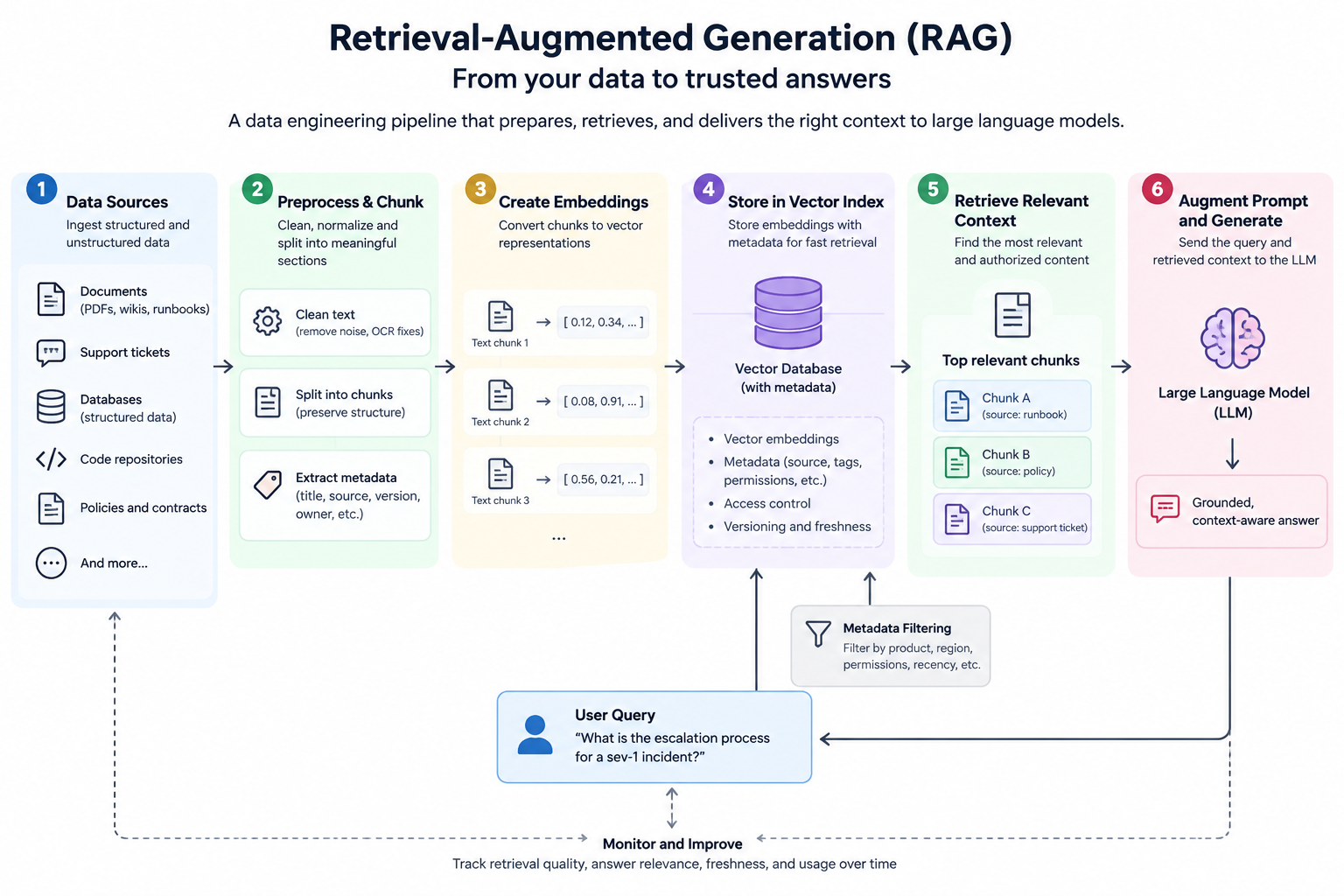
RAG pipeline showing how data is prepared and retrieved for large language models.
Where large language models add practical value in data engineering
The strongest large language model use cases are usually not the flashy ones. They are the ones that remove friction from work data teams and operators already do.
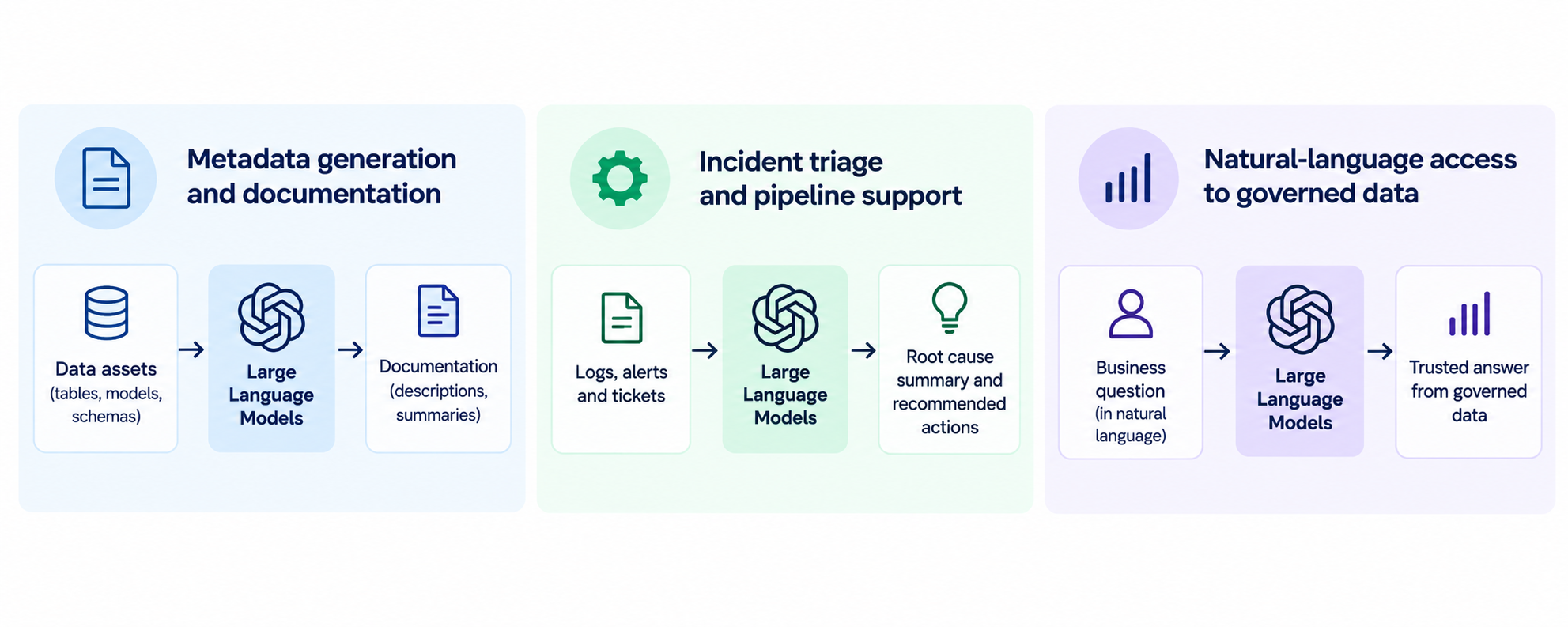
Practical data engineering use cases for large language models.
Metadata generation and documentation
Documentation is one of the least glamorous parts of data engineering, which is precisely why it often falls behind. Large language models can generate first-pass descriptions for datasets, columns, dbt models, schema changes, and lineage artifacts. They do not replace review, but they can improve discoverability, accelerate onboarding, and reduce the blank-page problem that keeps documentation stuck in “we’ll fix it later” mode.
Incident triage and pipeline support
When a production data pipeline fails, the first challenge is often understanding the problem quickly enough to respond well. Engineers bounce between alerts, logs, dashboards, tickets, and runbooks before the real fix even begins. Large language models can help summarize logs, compare current failures to historical incidents, surface likely root causes, and pull relevant remediation steps from internal runbooks. The value is not magic debugging. It is faster context assembly.
Natural-language access to governed data
Natural-language interfaces become valuable only when they sit on top of governed data and clear definitions. The interesting use case is not that someone can ask a question in English. The interesting use case is that a business user can ask for a metric, trend, or operational explanation and get a response grounded in approved semantic logic instead of improvised guesswork. Without trusted definitions, this pattern becomes a very elegant way to misunderstand your own business.
AI agents raise the bar in data engineering
If RAG asks the data pipeline for trusted context, AI agents ask for trusted context plus actionability. An agent may not only answer a question; it may choose a tool, query a system, retrieve a runbook, decide on a next step, or escalate an issue.
That raises the engineering bar. The supporting pipeline may need to provide current system state, task context, tool-ready data interfaces, permissions, runbooks, memory, and auditable event history. Agentic workflows are not only model problems. They are systems problems with operational consequences.
Imagine an internal incident agent monitoring failures in a production data pipeline. It pulls recent logs, compares them with prior incidents, retrieves the relevant runbook, identifies the likely service owner, and drafts a response plan. That workflow is useful only if the context is fresh, accurate, and properly scoped. If the agent sees stale guidance or the wrong ownership metadata, it can still act decisively. It will just act decisively in the wrong direction.
Governance, freshness, and monitoring become non-negotiable
As large language models and agents depend more heavily on internal data, governance becomes much more than a compliance formality. A weak dashboard may confuse someone. A weak answer grounded in stale or unauthorized content can create operational, legal, or security problems.
This is why modern data engineering has to care deeply about source approval, access control, lineage, retention, and freshness. A robust AI governance framework should account for all of these. Teams need to know which content is authoritative, which content is sensitive, and whether retrieved context reflects the latest state of the business. In practice, one of the most dangerous failure modes is not hallucination in the abstract. It is a model answering correctly according to last month’s document set.
Monitoring changes too. Traditional data pipeline monitoring focuses on broken jobs, schema drift, latency spikes, and missing partitions. LLM-powered systems need these checks plus retrieval evaluation, prompt drift monitoring, hallucination safeguards, output usefulness signals, and token cost tracking. Some issues are less obvious, such as a retriever surfacing weaker context or a stale embedding index, but they are still production issues.
A practical starting point
The practical way forward is not to pour large language models into every workflow like a universal seasoning. It is to start where language understanding clearly improves an existing process. Pick one workflow. Define the trusted sources. Clean and label the context. Set freshness expectations. Measure retrieval quality and output usefulness. Then monitor the system like a production system, because that is what it is.
Teams that do this well will not win because they used the fanciest model. They will win because they built cleaner source pipelines, stronger metadata, better retrieval, tighter governance, and clearer operational controls. In modern data engineering, context is quickly becoming the product.
FAQ
What makes data AI-ready?
AI-ready data is not just clean and structured. It also needs relevant metadata, preserved meaning, reliable source information, appropriate access controls, and freshness so that AI systems can retrieve trustworthy context.
How does RAG change data engineering?
RAG makes retrieval, freshness, metadata, and source control part of the data engineering responsibility. The pipeline must prepare and retrieve the right context before it reaches the large language model.
Why is metadata important for large language models?
Metadata helps systems understand what content represents, who owns it, whether it is authoritative and current, and how it relates to other data. This makes context easier to filter, retrieve, and govern.
Why do LLM-powered data systems need additional monitoring?
Traditional pipeline checks are still necessary, but LLM-powered systems also need retrieval evaluation, prompt drift monitoring, hallucination safeguards, output usefulness signals, and token cost tracking.
Want to build AI agents that can reason, plan, and execute autonomously?
Learn more