


Anthropic launched Claude Cowork in January 2026 and quietly shifted expectations for what an AI agent could do on a desktop. Two months later, Microsoft responded with Copilot Cowork, built in close collaboration with Anthropic and framed as “Wave 3” of Microsoft 365 Copilot. The names are nearly identical. The underlying AI model is the same. The two products, though, are built for fundamentally different contexts, and understanding that gap matters if you’re deciding which one belongs in your workflow.
The Origin Story
Anthropic went first
Claude Cowork shipped in January 2026 as a standalone desktop agent — running locally on a user’s machine, capable of executing long, multi-step tasks across applications. This is the natural evolution of where agentic AI has been heading — from systems that respond to systems that act. The release rattled investors. Microsoft’s stock dropped more than 14% in the weeks that followed, as markets read it as a direct threat to entrenched enterprise software.
Microsoft’s response wasn’t to compete, it was to partner
Rather than building a rival model from scratch, Microsoft leaned into a relationship with Anthropic that had already deepened considerably. In November 2025, Microsoft and Nvidia jointly announced strategic investments in Anthropic — Microsoft committing up to $5 billion, Nvidia up to $10 billion — while Anthropic committed to purchasing $30 billion in Azure compute capacity. Claude models became available across Microsoft Foundry, GitHub Copilot, and Microsoft 365 Copilot as part of that deal.
By January 2026, Microsoft was on track to spend around $500 million annually on Anthropic’s models, making it one of Anthropic’s largest customers. Copilot Cowork is the direct product of that deepening relationship — built on Claude’s agentic model and the same execution framework that powers Claude Cowork, then wrapped in Microsoft’s enterprise infrastructure.
“Working closely with Anthropic, we have integrated the technology behind Claude Cowork into Microsoft 365 Copilot.” — Microsoft 365 Blog, March 9, 2026
What is Copilot Cowork?
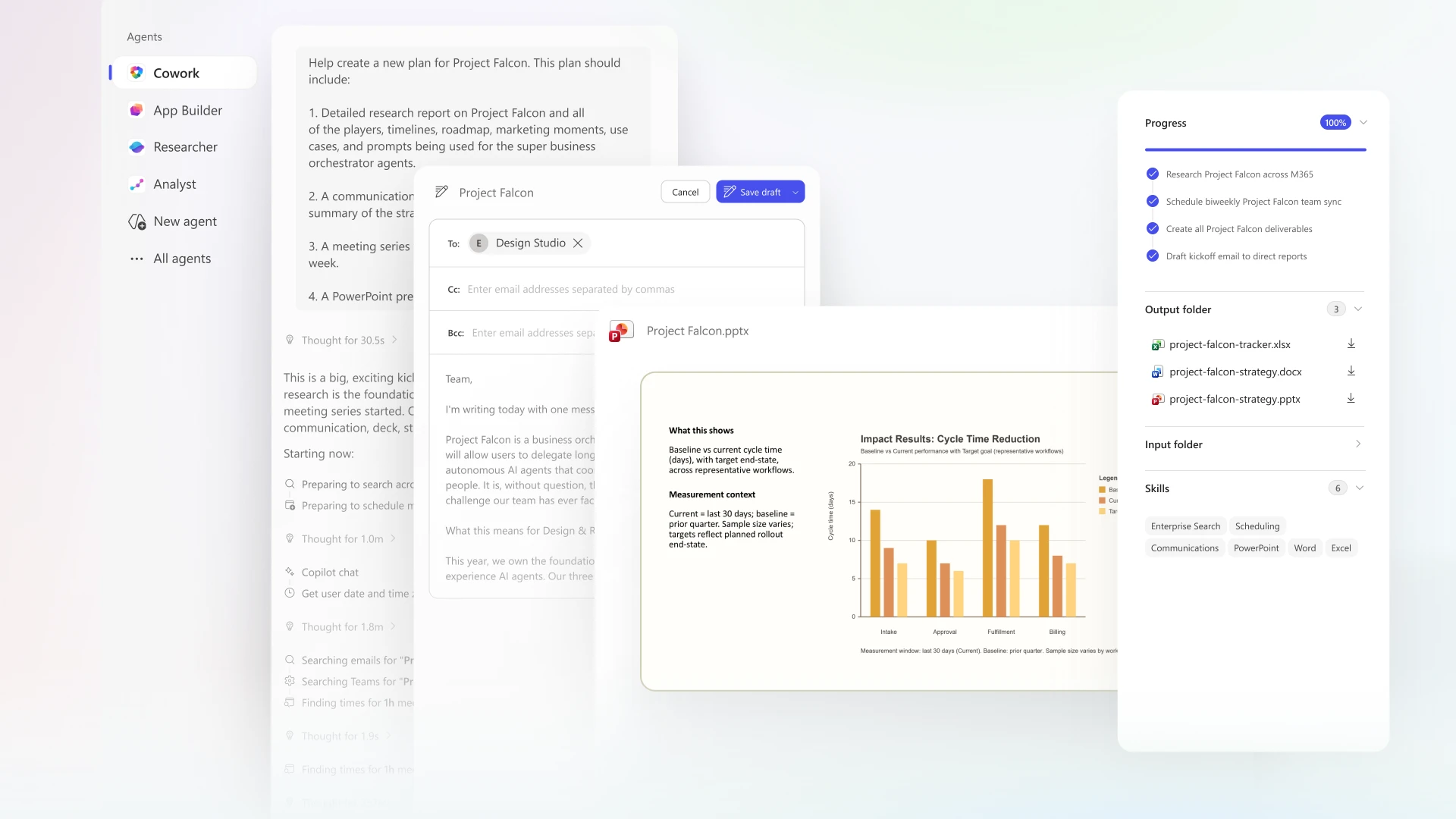
Microsoft Copilot Cowork is a desktop AI agent included in Microsoft 365 that autonomously manages file organization, meeting follow-ups, and cross-app task execution directly from the Windows environment without requiring browser access. Unlike the browser-based Copilot assistant, Cowork operates at the OS level, allowing it to take actions across local files, Outlook, Teams, and OneDrive simultaneously within a single workflow. Independent tests by enterprise IT teams show Cowork reduces repetitive administrative tasks — such as summarizing meeting notes and filing documents — by an average of 35 minutes per workday for knowledge workers. The product is positioned as Microsoft’s answer to Claude’s computer use and OpenAI’s Operator, targeting non-developer enterprise users who need automation without writing code.
Features and Capabilities
Both products are built for genuine task delegation — not just answering questions, but taking action. This is what separates agentic LLMs from traditional language models: you describe the outcome you want, the agent builds a plan, executes steps, checks in when it needs direction, and surfaces results. Where they diverge is in what that execution actually touches.
New to agentic AI? Get up to speed with What Is Agentic AI? Master 6 Steps to Build Smart Agents before diving into how these two products compare.
How Claude Cowork works
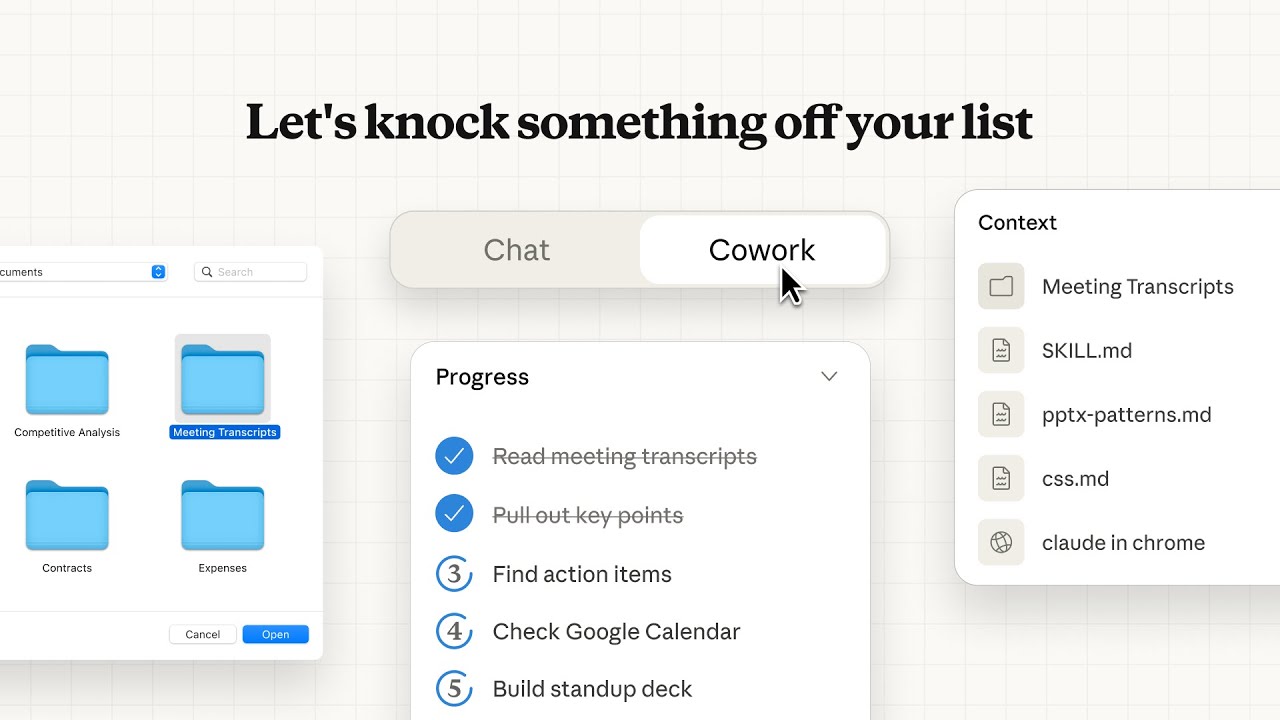
Claude Cowork runs locally on your device, which means it can interact with applications across any software environment on your machine. That flexibility suits power users and developers working across a varied stack — tasks can span tools Microsoft doesn’t own, and there’s no ecosystem dependency. The tradeoff is that it operates without organizational context: no shared calendar, no live email history, no company file structure to draw from.
How Copilot Cowork works
Copilot Cowork operates inside Microsoft 365 and draws on Work IQ, Microsoft’s intelligence layer built from a user’s emails, files, meetings, chats, and calendar across Outlook, Teams, Excel, and Word. When it prepares for a client meeting, it isn’t just generating a presentation, it’s pulling context from your recent email thread with that client, cross-referencing a shared spreadsheet, and scheduling prep time against your actual calendar. That depth of organizational context is something a locally-running agent structurally can’t replicate.
What both can do
The task categories overlap significantly: calendar triage, document drafting, competitive analysis, meeting preparation, and coordinated workflows across multiple files. In practice, both products reflect what Large Action Models are built to do — move from generating text to executing real workflows. The gap widens in team and cross-app scenarios where shared organizational context is the whole point, and that’s where Copilot Cowork pulls ahead for enterprise users.
Further reading: Large Action Models Explained: The Next Evolution Beyond LLMs — a deep dive into how AI agents move from language generation to real-world task execution.
Who Each Product Is Built For
Claude Cowork: individuals and builders
Claude Cowork is aimed at developers, researchers, and knowledge workers who want a capable desktop agent without going through an IT procurement process. Its local architecture means no organizational tenant, no administrator approval, no corporate cloud subscription required. You install it, and it works — which is exactly the point for users who move fast and don’t want guardrails they didn’t ask for.
Copilot Cowork: enterprise teams on Microsoft 365
Copilot Cowork is an enterprise product in every meaningful sense. It’s available to Microsoft 365 E5 customers and bundled into the new E7 Frontier Worker Suite, which means the buying decision runs through IT and procurement — not individual users. The governance integration is deliberate: it’s designed for organizations where uncontrolled AI agent activity is a security and legal liability, not just an inconvenience.
These two products are not really competing for the same buyer. A freelance developer or a small startup is more likely to reach for Claude Cowork. A large organization already standardized on Microsoft 365 is the natural home for Copilot Cowork — because the infrastructure it depends on to function well is already in place.
Security and Governance
This is where the architectural difference between the two products is sharpest.
Claude Cowork: local, flexible, limited oversight
Claude Cowork runs on the user’s device — useful for privacy in some contexts, but it leaves no centralized audit trail. There’s no governance layer, no way for an IT team to confirm what the agent accessed or what it produced. Jared Spataro, Microsoft’s CMO for AI at Work, called Claude Cowork “a fantastic tool” while noting it has real limitations in corporate environments: no access to cloud-based enterprise data, and security concerns at scale.
Copilot Cowork: cloud-based, auditable, governed by default
Copilot Cowork runs in the cloud within a customer’s Microsoft 365 tenant, inheriting the organization’s existing identity management, data protection policies, compliance boundaries, and audit capabilities. Every action is observable and logged. Documents it creates are immediately enterprise knowledge — covered by the same permissions as any other file in the organization’s ecosystem. For a CISO or compliance officer, that’s not a minor convenience; it’s the condition for deployment.
Microsoft Agent 365, launching May 1 at $15/user/month, adds a centralized control plane for monitoring agent behavior across an organization, identifying risks, and enforcing security policy templates — a governance layer that doesn’t exist in Claude Cowork’s model by design.
Pricing
Claude Cowork
Accessible as part of Anthropic’s standard Claude subscription, tiered by usage with no large organizational commitment required.
Copilot Cowork
Bundled into Microsoft’s enterprise subscription stack — available to E5 customers and fully included in the new Microsoft 365 E7 Frontier Worker Suite at $99 per user per month, a 65% jump from the $60 E5 tier. That price covers Copilot, AI agent management tools, identity governance, and the Cowork agentic capabilities as a package.
| Product | Access Model | Price | Target Buyer | Key Inclusions |
|---|---|---|---|---|
| Claude Cowork | Standalone subscription | Anthropic Claude plan pricing | Individuals, developers, small teams | Local desktop agent, cross-app task execution, no org setup required |
| Copilot Cowork | M365 E5 or E7 bundle | From ~$60/user/mo (E5) | Enterprise teams on Microsoft 365 | Work IQ context layer, M365 integration, enterprise data protection, audit trails |
| M365 E7 Frontier Suite | Enterprise subscription | $99/user/month | Large enterprises, IT-managed orgs | Full Copilot Cowork access, AI agent management, identity governance, Microsoft Agent 365 |
| Microsoft Agent 365 | Add-on | $15/user/month | Enterprise IT & security teams | Centralized agent monitoring, risk signals, security policy enforcement |
The Partnership Angle: Microsoft Built Their Answer Using Anthropic’s AI
The most telling thing about this launch is what it reveals about two companies that are, in some markets, direct competitors.
Anthropic demonstrated the concept; Microsoft commercialized it
Anthropic built Claude Cowork and in doing so showed — publicly and concretely — what a capable AI agent could look like in practice. If you’ve followed how Claude has evolved as a model family, this is a natural extension of Anthropic’s push into long-horizon, tool-using AI. Microsoft’s response wasn’t to build an equivalent from scratch — it was to take the same underlying agentic technology and deploy it inside the infrastructure Microsoft already controls. Spataro’s framing was candid: “What Anthropic has done is demonstrate the value of these agentic capabilities. Microsoft is all about commercialization.”
The financial logic runs both ways
Anthropic drives model quality and research. Microsoft provides distribution, enterprise trust, and the cloud infrastructure that turns a capable agent into something organizations can deploy at scale. The $30 billion Azure compute commitment from Anthropic and Microsoft’s $5 billion investment in Anthropic both point in the same direction — these companies see more value in deepening collaboration than in treating each other as pure rivals.
What it means for the platform
For developers evaluating which ecosystem to build on, Microsoft’s multimodel approach — routing tasks to Claude, GPT models, or its own models depending on the job — positions M365 as an AI aggregator rather than a monoculture. This mirrors a broader shift in how agentic systems are being architected, where the “best model for the task” pattern is replacing single-model deployments. Whether that holds as both Anthropic and OpenAI continue expanding their own enterprise offerings is one of the more interesting open questions in enterprise AI right now.
Related: From LLMs to SLMs: Redefining Intelligence in Agentic AI Systems — how the shift toward specialized, smaller models is reshaping how AI agents are built and deployed at scale.
So, Which One Is Right for You
Individual developer or power user — Claude Cowork is the more flexible option. It runs locally, doesn’t require a corporate subscription, and works across a broader range of tools. The organizational context it lacks won’t matter if you’re working independently.
Enterprise team on Microsoft 365 — Copilot Cowork is worth serious consideration precisely because it fits inside the governance and security architecture your organization already has. Work IQ and M365 integration depth are real advantages where data access and auditability matter. Research preview is live now for Frontier program participants, with broader availability expected by late March 2026.
Watching this as an industry signal — the Microsoft-Anthropic partnership is one of the clearest current examples of how frontier AI labs and large platform companies are finding ways to coexist rather than simply compete. Anthropic builds the model; Microsoft puts it in front of 400 million M365 users. The question is how long that dynamic holds as both sides keep building. For a deeper grounding in where this is all heading, our overview of agentic AI is a good place to start.
FAQ
Is Copilot Cowork the same as Claude Cowork?
No. Both use Anthropic’s Claude model and share the same agentic framework, but they’re distinct products built for different environments. Claude Cowork runs locally on a user’s device; Copilot Cowork runs in the cloud inside a Microsoft 365 tenant with enterprise governance controls.
Can I use Copilot Cowork without a Microsoft 365 subscription?
No — Copilot Cowork requires a Microsoft 365 commercial subscription at E5 or above, including the new E7 Frontier Worker Suite. It’s not available as a standalone product.
Is Claude Cowork suitable for enterprise use?
Claude Cowork runs locally and doesn’t include centralized governance, audit, or compliance infrastructure. It’s better suited for individual users or smaller teams where those requirements aren’t a factor.
What is Work IQ?
Work IQ is the intelligence layer built into Microsoft 365 Copilot. It draws on a user’s emails, files, meetings, chats, and calendar data to give Copilot — and Copilot Cowork — deep organizational context when executing tasks.
When will Copilot Cowork be broadly available?
It’s currently in research preview through Microsoft’s Frontier program. Broader availability is expected in late March 2026.
Wrapping Up
Claude Cowork and Copilot Cowork share the same name, the same underlying model, and the same core ambition — but they land in completely different places. Anthropic built something powerful for individuals and builders who want a capable agent on their own terms. Microsoft took that same technology and built something for the enterprise: governed, integrated, and deeply embedded in the tools most large organizations already run on.
The more interesting story here isn’t which product wins. It’s that Microsoft’s answer to Anthropic’s threat was to use Anthropic’s own AI to build it. That’s the partnership at work — and it says a lot about where enterprise AI is heading. The frontier is no longer about which company has the best model. It’s about who can take that model and deliver it inside the context, security, and workflow that organizations actually need.
For most individuals, Claude Cowork is the faster path to a capable desktop agent. For most enterprises, Copilot Cowork is the safer and more integrated bet. And for anyone watching the broader AI landscape — this partnership is worth keeping a close eye on.
Ready to build robust and scalable LLM Applications?
Explore our LLM Bootcamp and Agentic AI Bootcamp for hands-on training in building production-grade retrieval-augmented and agentic AI.