
A comprehensive program covering data science fundamentals, visualization, predictive modeling, model deployment, and advanced topics like text analytics and recommender systems.







This Data Science Bootcamp is for professionals ready to master end-to-end data workflows—from data wrangling and visualization to machine learning and model deployment.
Learn the full stack: Python, data processing, statistics, and machine learning. Build real projects, not just theory.
Expand your toolkit and learn to apply statistical models and machine learning to solve complex engineering and business problems.
Whether you come from finance, operations, IT, or another analytical field, this program provides the structure and skills to transition into data roles confidently.
Learn from though leaders at the forefront of end-to-end data workflows—from data wrangling and visualization to machine learning and model deployment.
Overview of the topics and practical exercises.
In this module, we’ll build the foundational programming knowledge and theory needed to succeed in the bootcamp. By covering essential Python concepts and tools, we’ll set ourselves up for a smoother learning experience during the hands-on sessions. Whether you’re starting from scratch or refreshing your skills, this module is the perfect starting point for mastering Python and its practical applications.
What You’ll Learn
In this module, we’ll focus on data exploration, visualization, and feature engineering—essential steps in preparing data for analysis. We’ll learn how to use techniques like summary statistics and visual tools to understand the structure of your data, spot patterns, and identify issues such as missing values or outliers. We’ll also cover how to transform and create new features that make your data more useful for modeling. By the end, you’ll be able to uncover insights, clean your data, and shape it for better analysis and predictive performance.
What You’ll Learn
In this module, we’ll explore how to turn raw data into compelling visual stories. We’ll learn how to choose the right visualizations for different data types, and apply tools like pandas, matplotlib, and seaborn to analyze real datasets. Through hands-on exercises, we’ll uncover key insights and develop a deeper understanding of the data. We’ll also discuss how to design and present visuals that clearly communicate the message to our audience. By the end of the module, you’ll be equipped to present data in a clear, impactful, and audience-friendly way.
What You’ll Learn
In this module, we’ll explore how to use predictive modelling to create real business impacts. We’ll learn to identify the right opportunities for machine learning, translate business goals into actionable models, and recognize when good models might still lead to poor outcomes. We’ll also cover essential data requirements and key ethical considerations. By the end, you’ll be able to understand predictive systems that are both effective and aligned with business strategy.
What You’ll Learn
In this module, we will explore decision tree learning and focus on how decision trees are constructed for supervised classification tasks. We will learn to apply splitting criteria like Gini index and how to evaluate model performance. Practical exercises and quizzes at the end will help you to apply the learned skills to real datasets and benchmark your performance. By the end of this module, you will be equipped to confidently implement decision tree classifiers.
What You’ll Learn
In this module, we’ll focus on evaluating classification models and understanding their impact in real-world applications. We’ll begin by discussing why accuracy alone isn’t a reliable metric and how different types of errors affect business decisions. Through the confusion matrix and key performance metrics like precision, recall, and F1 score, we’ll learn to interpret model results with clarity. We’ll also explore advanced evaluation tools like ROC curves and AUC to help us assess model performance across thresholds. By the end of this module, you’ll be able to choose appropriate metrics, interpret model results effectively, and make evaluation decisions that align with real-world goals.
What You’ll Learn
Master the essentials of hyperparameter tuning to improve your model’s accuracy and reliability. This module covers key concepts like generalization, overfitting, and the bias-variance tradeoff, alongside practical validation techniques and strategies to handle real-world data challenges. We’ll learn how to fine-tune models for better performance and robust predictions.
What You’ll Learn
Unlock the potential of ensemble methods and elevate your predictive power. This module aims to go deep into techniques such as bagging and random forests, explore key concepts like the bias-variance trade-off and out-of-bag evaluation, and build practical skills through interactive notebooks. Whether you’re working with messy real-world data or aiming for stronger model performance, ensemble learning is the next step forward!
What You’ll Learn
Boosting is a powerful ensemble technique that builds better models by learning from previous mistakes, one step at a time. In this course, we’ll explore the core ideas behind boosting, explore popular methods like AdaBoost, and apply them through real-world examples and hands-on exercises. Whether you’re just starting out or looking to sharpen your skills, this course will help you create smarter and more accurate predictive models.
What You’ll Learn
In today’s data-driven world, successful digital products are not built on guesswork. They’re built on evidence. This module will walk you through the essential principles and practical techniques of online experimentation. From understanding the basics of A/B testing to mastering advanced testing strategies and avoiding common pitfalls, you’ll gain the knowledge and confidence to run meaningful experiments that drive better outcomes. Whether you’re refining a feature, testing a new idea, or scaling insights across teams, this module sets the foundation for thoughtful, measurable, and impactful decisions.
What You’ll Learn
Every tweet, email, review, and support ticket holds valuable insights if we know how to extract them. This module introduces the tools and techniques businesses use to turn raw text into strategic decisions. We will learn how to clean, structure, and analyze text using NLP, TF-IDF, and word embeddings like Word2Vec. Whether you want to understand customer sentiment or automate tasks, this module will help you get started.
What You’ll Learn
Discover how unsupervised learning helps uncover hidden patterns in data without labels. This module introduces key concepts of clustering, with a focus on the k-means algorithm. We’ll learn how k-means works, when to use it, and how to choose the right number of clusters for meaningful insights from raw data.
What You’ll Learn
Discover how a simple straight line can unlock powerful insights and help predict the future. In this course, we’ll explore how linear models work, how to evaluate their performance, and how optimization techniques like gradient descent help improve accuracy. Through intuitive explanations and practical examples, we’ll learn to build, interpret, and apply linear regression models with confidence.
What You’ll Learn
What if our linear models could stay accurate and simple, even in messy real-world data? In this module, we will build models that balance precision and simplicity. We will learn how to control model complexity, use regularization to prevent overfitting, and tune hyperparameters so our models make reliable, real-world predictions.
What You’ll Learn
Ever wondered how Netflix knows what we’ll love next? This module unpacks the magic behind recommendation systems, from how they measure similarity and generate suggestions to choosing the right approach for your business. Discover how to use data-driven recommendations to boost engagement, delight customers, and drive results.
What You’ll Learn
Learn the core principles of big data engineering and distributed systems to confidently tackle large-scale data challenges. This module introduces key topics such as cloud infrastructure models, distributed computing frameworks, and scalable system design. We’ll use tools like Hadoop and Spark to process data efficiently and explore modern architectures that support real-time analytics and machine learning workflows.
What You’ll Learn
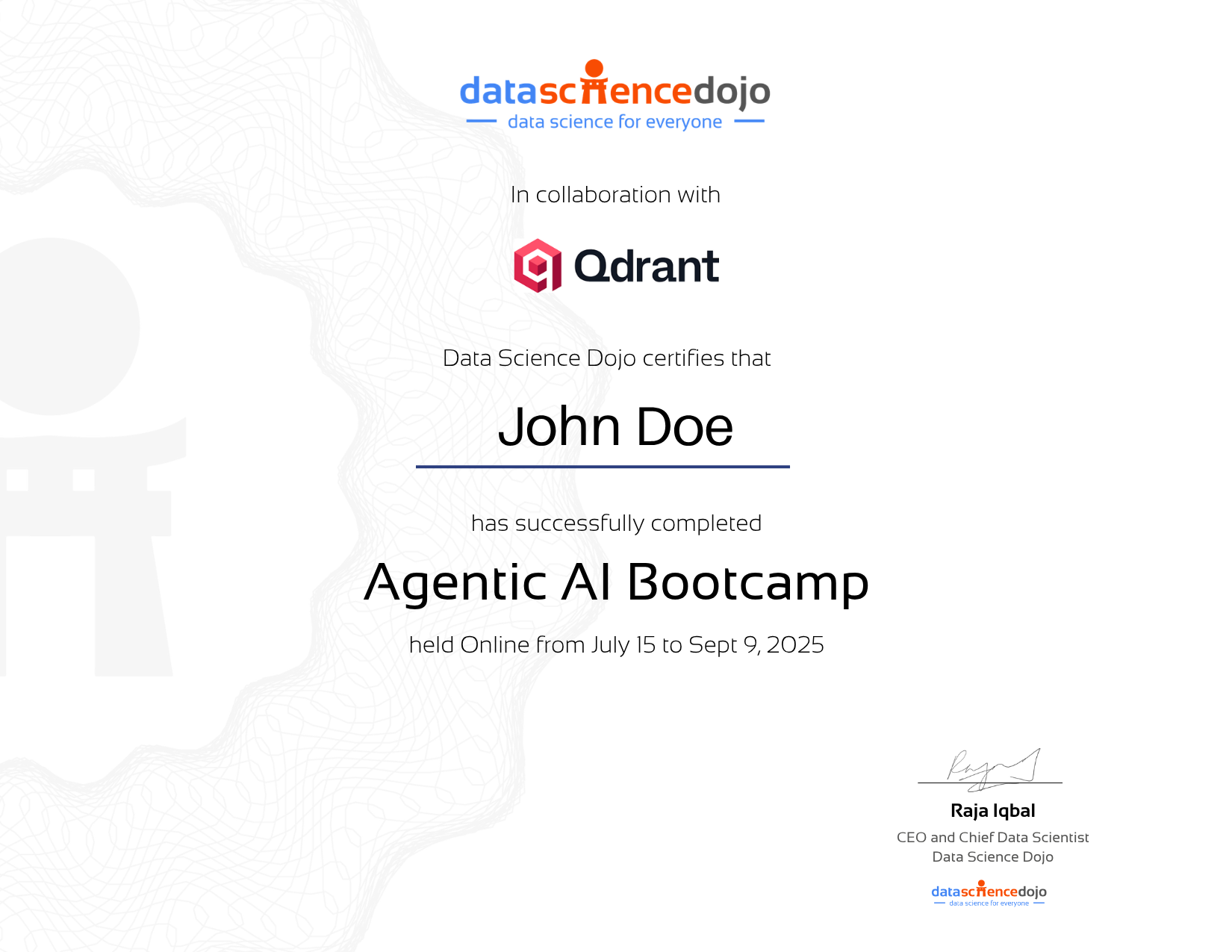
Earn a verified certificate and take your next career step with credibility.
All of our programs are backed by a certificate. This means that you may be eligible to attend the bootcamp for FREE.
We have carefully designed our data science bootcamp to bring you the best practical exposure in the world of data science, programming, and machine learning.
We are a technology-neutral and vendor-agnostic training. Both R and Python code samples will be shared with attendees.
While we do not provide exact recordings of the live sessions, all key topics and content covered during the class are available in our companion courses. We’ve created structured lesson clips that reflect the material discussed, allowing you to review everything at your convenience even if you miss a live session.
There is no difference between the online and in-person bootcamp in terms of curriculum and instructors. The only distinction is that breakfast, lunch, and beverages are provided at the in-person bootcamp.
No, we do not offer any in-person part-time options. The program requires a full-time commitment of 40 hours over 5 days.
If, for any reason, you decide to cancel, we will gladly refund your registration fee in full if you notify us at least five business days before the start of the training. We can also transfer your registration to another cohort if preferred.
However, refunds cannot be processed if you have transferred to a different cohort after registration. Additionally, once you have been added to the learning platform and have accessed the course materials, we are unable to issue a refund, as digital content access is considered program participation.
Yes! Once you have completed our Data Science Bootcamp, you will be issued a certificate that you can print or add to your LinkedIn profile for others to see.
You are expected to be in class for 8 hours each day.
We have had attendees from a wide range of backgrounds – software engineers, product/program managers, physicists, financial analysts – even medical doctors and veterinarians, attend and successfully completed our data science bootcamp. This bootcamp is for anyone who is curious about data science and willing to explore, segment, analyze, and understand their data in order to make better data-driven decisions. We recommend that you talk to one of our advisors before joining this data science bootcamp. If you would like to set up a time with one of our instructors, please let us know.
It depends on your capabilities and skills you have grasped while attending a bootcamp that will lead to a career track that you can choose in data analytics, but here are some jobs you can look forward to, based on your skillset:
Data Scientist
Data Engineer
Machine Learning Engineer
Data Analyst
Business Analyst / Product Analyst
Yes, our live instructor-led sessions are highly interactive. Students are encouraged to ask questions, and our instructors make sure to provide thorough responses without rushing. Additionally, discussions relevant to the topic being taught are actively encouraged. We also understand that questions may arise during homework. To support you, we have a dedicated Discord community where you can receive help from our instructors and connect with fellow students.
Transfers are allowed once with no penalty. Transfers requested more than once will incur a $200 processing fee.
Currently, this bootcamp is discontinued. We plan to relaunch it this year in a self-paced format. Once the updated structure and details are finalized, they will be shared here on our website.